
Picture this: billions of years ago, when Earth was just beginning to teem with life, Mars might have been home to tiny microbes too. What sounds like science fiction became scientific reality this week when NASA announced their most compelling evidence yet for ancient life on the Red Planet.
The Mars biosignature discovery has sent shockwaves through the scientific community, furthermore representing what NASA calls “the closest we’ve actually come to discovering ancient life on Mars.” Additionally, this Mars biosignature discovery stems from a rock sample that could preserve evidence of microbial life from over 3 billion years ago.
The Rock That Changed Everything: Meet “Cheyava Falls”
Deep within Mars’ Jezero Crater lies a rock formation that’s about to become famous. NASA’s Perseverance rover stumbled upon this arrowhead-shaped rock, nicknamed “Cheyava Falls,” while exploring what used to be an ancient riverbed. However, this wasn’t just any ordinary Martian rock.
When scientists first laid eyes on Cheyava Falls through Perseverance’s cameras, they immediately noticed something extraordinary. Moreover, the rock displayed distinctive “leopard spots” — dark-rimmed circular patterns with lighter centers that measured between 200 micrometers to 1 millimeter in diameter. These weren’t random markings; rather, they appeared to tell a story that stretched back billions of years.
The sample, called “Sapphire Canyon,” contains potential biosignatures according to a paper published in the journal Nature. Scientists think the spots may indicate that, billions of years ago, the chemical reactions in this rock could have supported microbial life.
But wait — there’s more to this story. Besides the leopard spots, researchers also discovered smaller features they playfully dubbed “poppy seeds.” These tiny, dark specks scattered throughout the mudstone told their own tale of ancient chemical processes.
What Makes This Mars Biosignature Discovery Different?
Previous Mars missions have found tantalizing hints of past habitability, but this discovery stands apart. Consequently, the chemical composition of these rock features suggests something remarkable happened here long ago.
The researchers identified tiny nodules and specks enriched in iron phosphate and iron sulfide that appear to have formed after sediment deposition, under low-temperature conditions. Furthermore, these minerals typically form through redox reactions — chemical processes where electrons transfer between substances.
Here’s where it gets exciting: on Earth, microorganisms often drive these exact same reactions. Additionally, they consume organic matter and produce these minerals as byproducts, essentially leaving behind their calling cards in rock formations.
Joel Hurowitz, the lead researcher from Stony Brook University, explained it this way: “When we see features like this in sediment on Earth, these minerals are often the byproduct of microbial metabolisms that are consuming organic matter and making these minerals as a result of those reactions.”
The Chemical Fingerprints of Life
What makes this Mars biosignature discovery so compelling? The rock contains several key ingredients:
Organic carbon — the building blocks of life as we know it Iron phosphate minerals — likely vivianite, which forms in environments with water Iron sulfide minerals — possibly greigite, associated with microbial sulfate reduction Perfect preservation conditions — the mudstone acted like a time capsule
Moreover, the spatial arrangement of these minerals follows patterns remarkably similar to what we see in Earth’s sediments where microbes have been active.
The Ancient Martian Environment: A Perfect Storm for Life
The Bright Angel formation, where Cheyava Falls resides, paints a picture of an ancient Mars that was strikingly different from today’s frozen desert. Consequently, this region was once part of Neretva Vallis, a quarter-mile-wide river valley that channeled water into Jezero Crater more than 3 billion years ago.
Think about it: we’re talking about a time when Mars had flowing water, protective atmospheres, and possibly the right chemistry for life to take hold. Additionally, the mudstone composition — rich in clay and silt — provided excellent conditions for preserving any biological signatures.
The sedimentary rocks were found to contain clay and silt, along with organic carbon, sulfur, rust (oxidized iron) and phosphorus. These elements represent the perfect recipe for supporting microbial metabolisms, particularly the types that might have thrived in Mars’ early, more hospitable environment.
Scientific Skepticism Meets Excitement
Scientists are notoriously cautious, especially when it comes to claims about extraterrestrial life. However, even the most skeptical researchers are taking notice of this Mars biosignature discovery.
“Astrobiological claims, particularly those related to the potential discovery of past extraterrestrial life, require extraordinary evidence,” said Katie Stack Morgan, Perseverance’s project scientist. “Getting such a significant finding as a potential biosignature on Mars into a peer-reviewed publication is a crucial step in the scientific process.”
The research team spent over a year analyzing the data before publication, moreover ensuring their findings met the rigorous standards of peer review. Nevertheless, they’re careful to emphasize that this represents a “potential biosignature” — evidence that suggests but doesn’t definitively prove biological origin.
What sets this discovery apart from previous claims? Unlike the controversial 1996 meteorite findings that sparked decades of debate, this Mars biosignature discovery comes from direct, in-situ analysis by a sophisticated rover equipped with state-of-the-art instruments.
The Technology Behind the Discovery
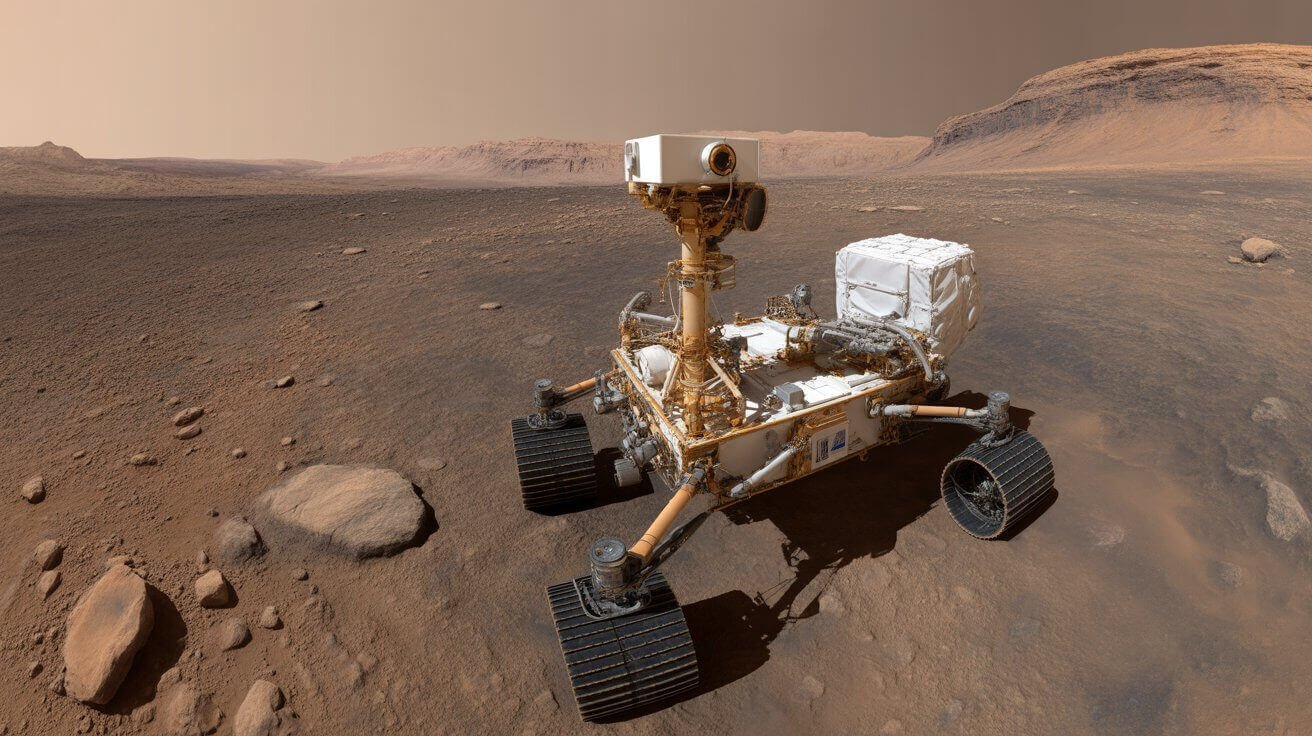
Perseverance’s investigation of Cheyava Falls reads like a forensic investigation. The rover employed multiple instruments to build a comprehensive picture:
PIXL (Planetary Instrument for X-ray Lithochemistry) mapped the rock’s elemental composition with incredible precision SHERLOC (Scanning Habitable Environments with Raman & Luminescence for Organics & Chemicals) detected organic carbon signatures WATSON captured detailed microscopic images of the rock’s surface features SuperCam provided additional spectroscopic analysis
Together, these tools painted a detailed picture of the rock’s chemistry and structure, furthermore enabling scientists to identify the specific minerals and their spatial relationships.
What This Could Mean for Life in the Universe
If confirmed, this Mars biosignature discovery would represent a watershed moment in our understanding of life’s prevalence in the cosmos. Consider the implications: if life emerged independently on two planets in the same solar system, it suggests biology might be far more common than we ever imagined.
“This finding by Perseverance…is the closest we have ever come to discovering life on Mars,” said acting NASA administrator Sean Duffy. “The identification of a potential biosignature on the Red Planet is a groundbreaking discovery, and one that will advance our understanding of Mars.”
Moreover, the types of organisms potentially indicated by these signatures — microbes that derive energy from chemical reactions rather than sunlight — represent some of the most primitive and resilient forms of life on Earth. Therefore, their presence on ancient Mars would suggest life can adapt to a remarkably wide range of environmental conditions.
The Next Critical Step: Getting Samples Back to Earth
Here’s where the story gets even more interesting. Perseverance has carefully collected and sealed the Sapphire Canyon sample in a titanium tube, consequently storing it for potential future return to Earth. Additionally, this sample represents one of 30 specimens the rover has collected during its mission.
The Mars Sample Return mission, however, faces significant challenges. Furthermore, budget constraints and technical complexities have put the program under intense scrutiny. Nevertheless, scientists argue that bringing these samples back represents the only way to definitively determine whether the features in Cheyava Falls have biological origins.
Bringing the core sample back would let researchers analyze it with specialized, highly sensitive instruments that would “determine the origin of the minerals, organics and textures it contains”.
Consequently, instruments on Earth can perform isotopic analysis, search for microfossils, and conduct experiments impossible with current robotic technology on Mars.
Challenges and Alternative Explanations
Responsible science demands considering alternative explanations, and this Mars biosignature discovery is no exception. Researchers have thoroughly examined whether non-biological processes could account for the observed features.
Several abiotic mechanisms could potentially create similar mineral assemblages:
- High-temperature reactions (though evidence suggests low-temperature formation)
- Acidic chemical processes (not supported by the geological context)
- Complex organic chemistry without biological involvement
However, after extensive analysis, the research team concluded that abiotic explanations for what they observe are “less likely given the paper’s findings”, though they cannot completely rule them out.
Beyond the Mars Biosignature Discovery: Future Mars Exploration
This Mars biosignature discovery is already reshaping how scientists approach the search for life beyond Earth. Moreover, it validates the strategy of exploring ancient lakebeds and river deltas where conditions might have supported microbial ecosystems.
Future missions will likely focus on similar environments, furthermore seeking additional evidence to corroborate these findings. The European Space Agency’s ExoMars mission and future NASA rovers will build upon these discoveries. Additionally, the success of Perseverance’s investigation demonstrates the power of combining multiple analytical techniques in a single robotic platform.
The discovery also highlights the importance of sample return missions. Consequently, while robotic analysis can identify compelling candidates for biosignatures, definitive confirmation requires the sophisticated laboratories available only on Earth.
Mars Biosignature Discovery: Are We Alone in the Universe?
This Mars biosignature discovery brings us tantalizingly close to answering one of humanity’s most profound questions: Are we alone in the universe? Moreover, if microbial life once thrived in the ancient lakes and rivers of Mars, it suggests life might be far more resilient and widespread than we previously imagined.
The implications extend beyond Mars itself. Furthermore, similar environments likely existed on other worlds throughout the solar system’s history. Consequently, moons like Europa and Enceladus, with their subsurface oceans, become even more compelling targets in the search for life.
Think about it: we’re potentially on the verge of discovering that life emerged independently on at least two worlds in our own cosmic neighborhood. Additionally, if that’s true, the universe might be teeming with biological activity in ways we’re only beginning to comprehend.
Conclusion: A New Chapter in Astrobiology
The Mars biosignature discovery represents more than just another scientific finding — it’s a potential paradigm shift in our understanding of life’s place in the cosmos. While definitive confirmation awaits the return of samples to Earth, moreover the evidence already challenges us to expand our conception of where and how life might arise.
As we stand on the threshold of potentially confirming ancient life on Mars, we’re reminded that the universe continues to surprise us. Furthermore, each discovery brings us closer to understanding not just whether we’re alone, but how common life might be throughout the galaxy.
The red planet has already revealed flowing water, complex chemistry, and now potential biological signatures. What other secrets might it hold? Moreover, what does this mean for our place in the vast cosmic story? Only time — and continued exploration — will tell.