
Imagine sitting at home when suddenly, without warning, millions of gallons of water start pouring from your local dam. Furthermore, this isn’t a natural disaster – it’s hackers with their fingers on the floodgates. The recent Norwegian dam incident has exposed how vulnerable our most critical systems really are, highlighting severe infrastructure cybersecurity threats that most people never think about. Moreover, this attack demonstrates that infrastructure cybersecurity threats are no longer theoretical risks but real, immediate dangers to our daily lives.
Here’s what happened in April 2025, and why it should keep you awake at night.
The Attack: Critical Infrastructure Cybersecurity Breakdown in Norway
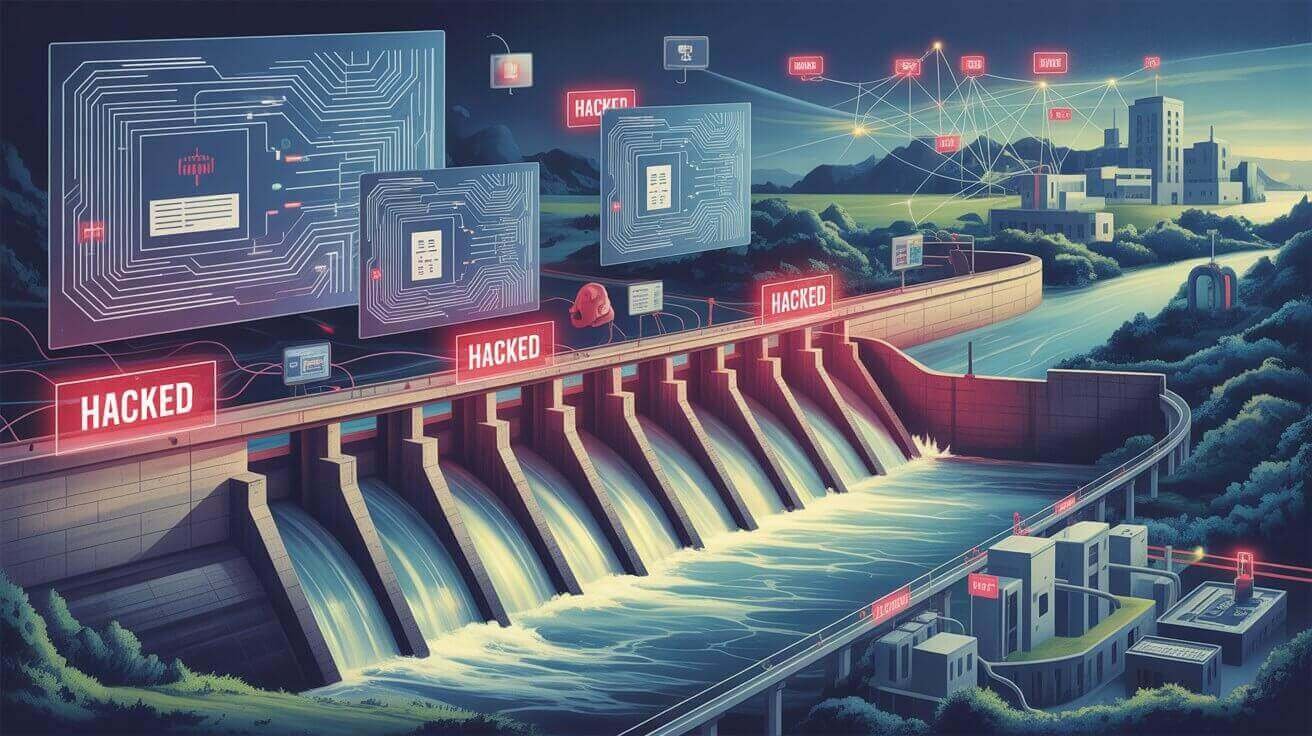
On a quiet spring day in Bremanger, western Norway, pro-Russian hackers seized control of a hydropower dam’s computer systems. Additionally, they opened the floodgate remotely, releasing 132 gallons of water per second for four straight hours.
That’s over 1.9 million gallons of water – equivalent to three Olympic-sized swimming pools – flowing uncontrolled before anyone noticed something was wrong.
Norwegian Police Security Service (PST) chief Beate Gangås confirmed this wasn’t just a random hack. Instead, it was a calculated demonstration of power. “They don’t necessarily aim to cause destruction, but to show what they are capable of,” she explained during a national security briefing.
But here’s the terrifying part: the hackers didn’t just get lucky. Moreover, they exploited a web-accessible control system protected only by a weak password. Furthermore, they even posted a three-minute video on Telegram showing the dam’s control panel, watermarked with their hacking group’s logo.
This wasn’t sophisticated espionage. Consequently, it was embarrassingly simple – and that makes it infinitely more dangerous.
Why This Matters: Infrastructure Security Threats Escalating Globally
The Norwegian incident represents just one example of escalating infrastructure cybersecurity threats across the globe. However, experts warn that this attack pattern is becoming the new normal, not an isolated incident.
The Scale of the Problem A 2024 Censys scan revealed over 145,000 industrial control systems exposed to the public internet worldwide. Additionally, more than 48,000 of these vulnerable systems are located in the United States alone.
These systems control everything from power grids and water treatment plants to transportation networks and healthcare facilities. Furthermore, many still use default passwords or easily guessed credentials that any determined attacker can crack.
The AI Amplification Effect Recent cybersecurity research shows that artificial intelligence is dramatically lowering the barriers to sophisticated attacks. Moreover, AI-powered tools can now bypass traditional defenses with breakout times as short as 51 seconds.
This means attackers can identify vulnerabilities, craft targeted exploits, and execute attacks faster than human defenders can respond. Consequently, the window for preventing or stopping these attacks is shrinking rapidly.
State-Sponsored Escalation The Associated Press has documented more than 70 incidents across Europe blamed on Russian-backed actors since Moscow’s invasion of Ukraine. Additionally, these attacks range from vandalism to arson and attempted assassination.
Norway’s intelligence chief characterized Russia as an “unpredictable neighbor” and the country’s biggest security threat. Furthermore, the dam attack fits a pattern of hybrid warfare designed to create fear and demonstrate capabilities without crossing into open warfare.
The Vulnerability Crisis: How Cybersecurity Threats Target Connected Infrastructure
Modern critical infrastructure faces a fundamental security paradox. Moreover, the same connectivity that makes systems efficient and manageable also makes them vulnerable to remote attacks.
Legacy Systems Meet Modern Threats Many critical infrastructure systems were designed decades ago when cybersecurity wasn’t a primary concern. Additionally, these legacy technologies weren’t built to withstand modern cyber threats, leaving them exposed to exploitation.
Furthermore, upgrading these systems often proves difficult because they control essential services that can’t be taken offline for extended periods. Consequently, operators frequently apply security patches retroactively rather than building protection from the ground up.
The Internet Connection Dilemma Critics rightfully ask: why connect critical infrastructure to the internet at all? However, the reality is more complex. Modern operations require remote monitoring, automated control, and real-time data collection to function efficiently.
Additionally, private industry prioritizes cost reduction and operational efficiency. Therefore, internet connectivity often wins over air-gapped security because it enables remote operation with fewer on-site personnel.
But as one security expert noted: “We continue to be amazed, baffled, and terrified that critical infrastructure hasn’t been disconnected from the public internet.”
Real-World Impact: When Infrastructure Cybersecurity Fails
The Norwegian dam incident didn’t cause casualties because the water levels were well below flood capacity. However, other infrastructure cybersecurity threats have had devastating real-world consequences.
Ukraine’s Blackout Attacks In 2015, Russian-backed hackers targeted three Ukrainian utility companies with BlackEnergy malware, leaving hundreds of thousands without electricity for six hours. Moreover, this marked the first known power outage caused by a malicious cyberattack.
The attackers targeted SCADA (supervisory control and data acquisition) systems that manage power distribution. Additionally, they likely began with simple phishing emails that gave them access to critical control systems.
Growing Attack Frequency US cyber-security officials report a 20% increase in cyber investigations against critical infrastructure in 2015, with attacks against critical manufacturing doubling that year.
Furthermore, recent research indicates that the healthcare industry alone is expected to spend $125 billion on cybersecurity from 2020 to 2025, with growing investment across all critical sectors.
Cascading Failure Risks Perhaps most concerning is the interconnected nature of modern infrastructure. Moreover, the failure of one critical system can trigger a devastating chain reaction across multiple sectors.
For example, a power grid attack could simultaneously disable communications, water treatment, healthcare systems, and transportation networks. Consequently, attackers can cause disproportionate damage by targeting single points of failure.
The AI Arms Race: Fighting Advanced Cybersecurity Threats
Artificial intelligence is fundamentally changing the infrastructure cybersecurity threats landscape, creating both new vulnerabilities and potential solutions.
AI-Powered Attack Evolution Cybersecurity experts predict that by 2025, we’ll see “full-scale machine-versus-machine warfare” where AI systems engage in real-time combat with adversarial AI.
Additionally, groups like CYBERAV3NGERS are already leveraging generative AI tools such as ChatGPT to enhance their attack tactics. Furthermore, these AI-enhanced attacks can evade traditional detection systems and adapt to defenses in real-time.
Defensive AI Solutions However, AI also offers powerful defensive capabilities. Machine learning algorithms can analyze enormous volumes of data to identify patterns associated with known and emerging cyberattacks.
Moreover, AI-powered systems can provide real-time threat detection, automated response mechanisms, and predictive analytics to anticipate attacks before they occur. Additionally, these systems continuously improve their detection capabilities by learning from previous incidents.
The Implementation Challenge The Trump administration’s AI Action Plan calls for critical infrastructure owners to deploy AI tools for protection, particularly those with limited financial resources.
However, implementing AI security solutions requires significant expertise and resources that many organizations lack. Furthermore, AI systems themselves can be vulnerable to manipulation through data poisoning and prompt injection attacks.
What You Can Do: Protecting Against Infrastructure Threats
While individuals can’t directly secure national infrastructure, understanding these threats helps inform personal and professional security decisions.
For Individuals:
- Stay informed about infrastructure vulnerabilities in your area
- Maintain emergency supplies (water, food, backup power) in case of service disruptions
- Support political candidates who prioritize cybersecurity funding
- Report suspicious activities around critical infrastructure to authorities
For Organizations:
- Implement air-gapped systems for critical operations when possible
- Use multi-factor authentication and strong, unique passwords for all systems
- Conduct regular security audits and penetration testing
- Train employees to recognize and report social engineering attempts
- Develop incident response plans for various attack scenarios
For Policymakers:
- Increase funding for critical infrastructure cybersecurity
- Mandate security standards for internet-connected industrial systems
- Promote information sharing between public and private sectors
- Invest in AI-powered defensive capabilities
- Establish clear consequences for attacks on critical infrastructure
Future Implications: Evolving Infrastructure Cybersecurity Challenges
The Norwegian dam attack signals a dangerous escalation in infrastructure cybersecurity threats that will likely intensify in coming years.
Hybrid Warfare Evolution Nation-states are increasingly using cyberattacks to exert pressure without crossing traditional warfare thresholds. Moreover, these attacks allow adversaries to demonstrate capabilities, gather intelligence, and potentially prepare for future conflicts.
Additionally, the line between cybercriminal groups and state actors continues to blur, making attribution and response more complex.
Technology Convergence Risks As quantum computing advances, current encryption methods may become obsolete, leaving critical infrastructure even more vulnerable to attack.
Furthermore, the integration of 5G networks, Internet of Things devices, and edge computing creates new attack vectors that adversaries can exploit.
Private Network Solutions Industry experts predict 2025 could be the tipping point for private wireless networks entering the mainstream for critical infrastructure protection.
These networks provide greater control by keeping traffic on-site and enabling tighter access controls. Additionally, they can be customized with dedicated resources to build tailored security architectures.
The Bottom Line: Wake-Up Call for Digital Security
The Norwegian dam incident should serve as a wake-up call about the fragility of our digital infrastructure. Moreover, this attack demonstrates that infrastructure cybersecurity threats pose immediate, tangible risks to public safety and national security.
While the Bremanger attack didn’t cause casualties, it revealed how easily critical systems can be compromised. Furthermore, the hackers’ ability to control water flow for four hours undetected highlights dangerous gaps in monitoring and response capabilities.
The implications extend far beyond Norway. Additionally, similar vulnerabilities exist in critical infrastructure worldwide, from power grids and water systems to transportation networks and healthcare facilities.
As artificial intelligence amplifies both attack capabilities and defensive potential, the stakes continue to rise. Consequently, the race between cyber attackers and defenders will determine whether our increasingly connected world becomes more secure or more vulnerable.
The Norwegian hackers sent a clear message: they can reach our most critical systems anytime they want. Moreover, the question isn’t whether future attacks will occur, but when and how devastating they’ll be.