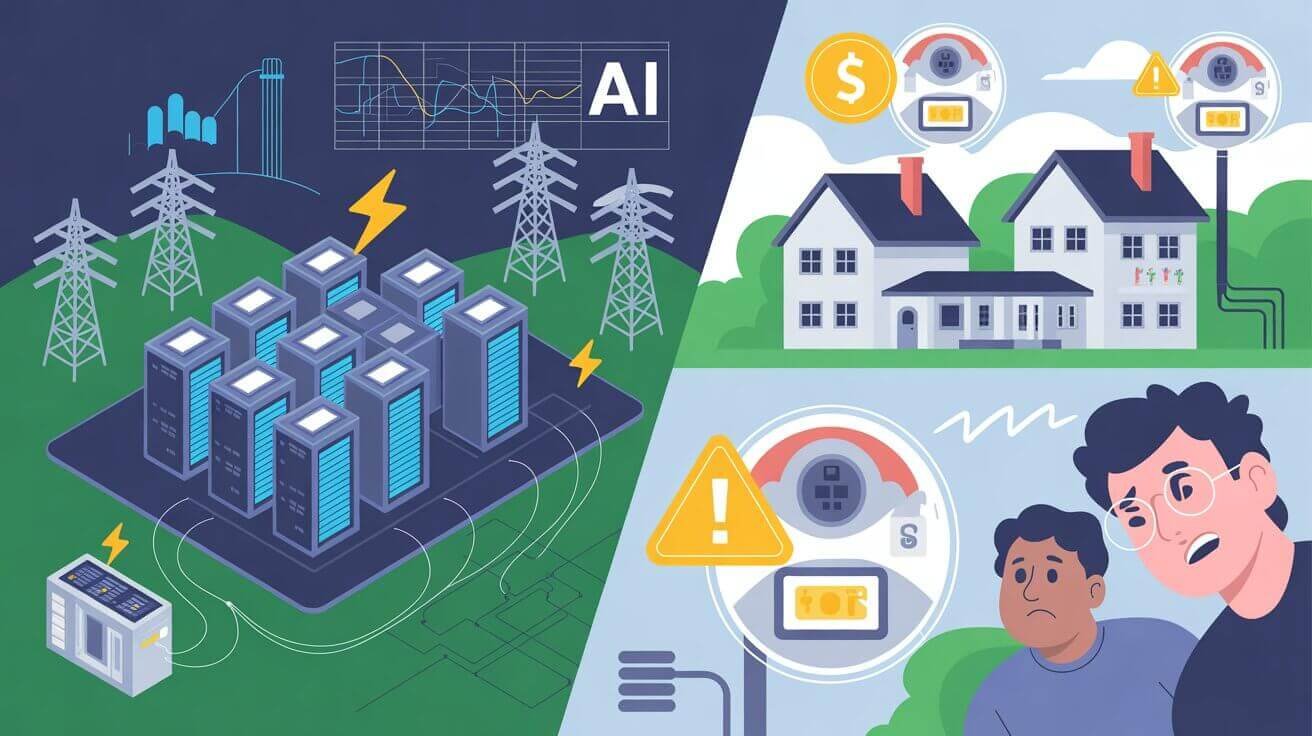

Your electricity bill probably jumped this summer, and you might be wondering why. While you’ve been asking ChatGPT to write your emails and generate images, the AI electricity demand impact has been silently reshaping America’s power grid—and your monthly utility costs. This AI electricity demand impact isn’t just a tech industry problem anymore; it’s becoming every household’s reality as data centers consume unprecedented amounts of power to fuel our AI-driven world.
Across the country, families are seeing monthly increases of $15 to $37 on their electric bills, and experts warn this is just the beginning. Moreover, the surge in electricity consumption isn’t slowing down—it’s accelerating at a pace that’s catching utility companies completely off guard.
AI Electricity Demand Impact on America’s Power Grid Infrastructure
The numbers behind AI’s energy appetite are staggering. According to the International Energy Agency, global electricity demand from data centers will more than double by 2030, reaching 945 terawatt-hours—roughly equivalent to Japan’s entire electricity consumption. Furthermore, AI-optimized data centers specifically will see their power consumption quadruple during this same period.
Here’s what’s driving this massive energy surge:
ChatGPT alone uses over 500,000 kilowatt-hours per day to operate. Additionally, that’s equivalent to powering 17,000 average American homes. Meanwhile, a single AI search consumes 10 times more electricity than a regular Google search, according to the Electric Power Research Institute.
The scale becomes even more mind-blowing when you consider upcoming projects. OpenAI and President Trump’s Stargate initiative plans to build 10 massive data centers, each requiring five gigawatts of power—more than the entire state of New Hampshire consumes.
Why Data Centers Create Massive Electricity Demand Impact
Data centers don’t just run computers; they’re essentially small cities that never sleep. These facilities require massive amounts of electricity for two main purposes:
Processing Power: Modern AI models like GPT-4 need enormous computational resources. Training GPT-4 alone consumed 50 gigawatt-hours of energy—enough to power San Francisco for three days, as reported by MIT Technology Review.
Cooling Systems: All those servers generate tremendous heat. Consequently, about 35-40% of a data center’s energy consumption goes toward cooling systems that prevent the equipment from overheating.
The Hidden Costs: How AI Power Demand Impact Hits Your Wallet
The connection between AI and your rising electric bill isn’t immediately obvious, but it’s very real. Utility companies are passing the costs of meeting this explosive demand directly to consumers through higher rates and infrastructure fees.
Real-World Bill Increases Across America
The impact varies by region, but the trend is consistent everywhere:
- New Jersey: Residents faced electricity bill increases up to 20% starting June 2025, with data centers cited as a key driver by the state’s public utilities board
- Ohio: Average households are paying an additional $15-27 per month this summer due to data center demand, according to CBS News reporting
- Virginia: The state legislature estimates residents could see monthly increases of $14-37, potentially reaching $450 annually by 2040
Perhaps most concerning, a PJM grid operator analysis found that data centers accounted for over 60% of capacity price increases in recent auctions—representing $9.3 billion in costs that will be passed to customers.
The Utility Company Shell Game
Here’s how utilities are shifting AI infrastructure costs to everyday customers:
Infrastructure Subsidies: When tech giants like Meta or Google build massive data centers, they often receive discounted electricity rates. However, utilities then spread the infrastructure costs across all customers to maintain their profit margins.
Capacity Market Pricing: Utilities must ensure they have enough power generation capacity for peak demand. Since data centers create massive new demand, capacity prices have skyrocketed—costs that get added to everyone’s bills.
Transmission Upgrades: Building new power lines and substations to serve data centers costs billions. Even though these upgrades primarily benefit tech companies, the costs are typically “socialized” across all ratepayers.
Regional AI Electricity Impact: Powerhouse States vs. Struggling Grids
The AI electricity demand impact varies dramatically across different regions, creating winners and losers in America’s energy landscape.
States Managing AI Demand Impact Successfully
According to CNBC’s analysis, certain states are better positioned to handle AI’s massive power demands:
Utah: The state aims to double power production by 2025 while maintaining affordable rates. Their Strategic Energy Plan prioritizes keeping costs low for citizens while expanding capacity.
Iowa: Leading the nation in wind power generation, Iowa has successfully transitioned from coal dependence. The state’s renewable energy infrastructure provides a more sustainable foundation for data center growth.
South Dakota: Maintains one of the most reliable electrical grids in the nation, offering stability for energy-intensive AI operations.
Regions Facing Crisis
Other areas are struggling under the pressure:
Mid-Atlantic States: The PJM grid region covering 13 states plus Washington D.C. is experiencing severe strain. Grid operators warn of potential capacity shortages as early as 2025.
Northern Virginia: Known as “Data Center Alley,” this region already hosts the world’s highest concentration of data centers. Consequently, Virginia’s data centers could consume nearly half the state’s total electricity by 2030.
Policy Solutions for Managing AI Electricity Demand Impact
Addressing the AI electricity demand impact requires immediate policy action and long-term infrastructure planning. Experts propose several solutions to prevent a complete grid crisis.
Smart Regulation Approaches
Fair Cost Allocation: Harvard Law School research suggests requiring tech companies to pay the full infrastructure costs for their data centers rather than subsidizing them through consumer rates.
Demand Response Programs: Utilities can incentivize data centers to reduce power consumption during peak demand periods, similar to programs already used for cryptocurrency mining.
Efficiency Standards: Implementing energy efficiency requirements for AI data centers could significantly reduce their power consumption without limiting functionality.
Infrastructure Investment Strategies
The scale of needed investment is enormous. Goldman Sachs Research estimates approximately $720 billion in grid spending will be required through 2030 to meet AI-driven demand.
Transmission Upgrades: Building new power lines and substations takes years to permit and construct, creating potential bottlenecks for data center growth if regions don’t act proactively.
Clean Energy Integration: Pairing data center development with renewable energy projects could help offset the environmental impact while meeting demand.
Nuclear Renaissance: Companies like Microsoft are restarting nuclear power plants specifically to power their AI infrastructure, though this approach raises questions about waste management and safety.
What the AI Electricity Demand Impact Means for Your Energy Future
The AI electricity demand impact will continue growing as artificial intelligence becomes more sophisticated and widespread. Understanding these trends helps you prepare for what’s coming.
Immediate Actions You Can Take
Monitor Your Bills: Start tracking your monthly electricity costs to identify AI-related increases in your area. Many utility companies aren’t transparent about the specific drivers of rate hikes.
Energy Efficiency Upgrades: Since electricity prices will likely keep rising, investing in energy-efficient appliances and home improvements becomes more financially attractive.
Local Advocacy: Attend public utility commission meetings in your area. Citizens can influence how utilities allocate costs between data centers and residential customers.
Long-Term Considerations
Regional Migration: If you’re planning to relocate, consider the energy infrastructure and policies in different states. Areas with abundant clean energy and fair utility regulations will likely see smaller bill increases.
Investment Opportunities: The massive infrastructure buildout creates investment opportunities in renewable energy, grid modernization, and energy storage companies.
Technology Adoption: Ironically, AI tools for home energy management could help offset some of the increased costs by optimizing your household electricity usage.
The Bottom Line: Preparing for an AI Power Demand Impact Future
The AI electricity demand impact represents both a crisis and an opportunity for America’s energy system. While current policies often shift costs to consumers, this surge in demand could accelerate the transition to cleaner, more efficient power generation if managed properly.
The key insight for consumers is understanding that your rising electricity bills aren’t just about inflation or fuel costs—they’re directly connected to the AI revolution happening in data centers across the country. Furthermore, this trend will accelerate as AI becomes more powerful and pervasive in our daily lives.
Smart policy decisions made today will determine whether AI’s massive energy appetite leads to affordable clean power for everyone or creates an unsustainable burden on American families. The technology itself isn’t the problem; it’s how we choose to pay for the infrastructure that makes it possible.
Therefore, staying informed about utility policies in your area and advocating for fair cost allocation will be crucial as we navigate this energy transformation. The AI revolution is here to stay, but we still have time to ensure its benefits don’t come at the expense of affordable electricity for everyday Americans.