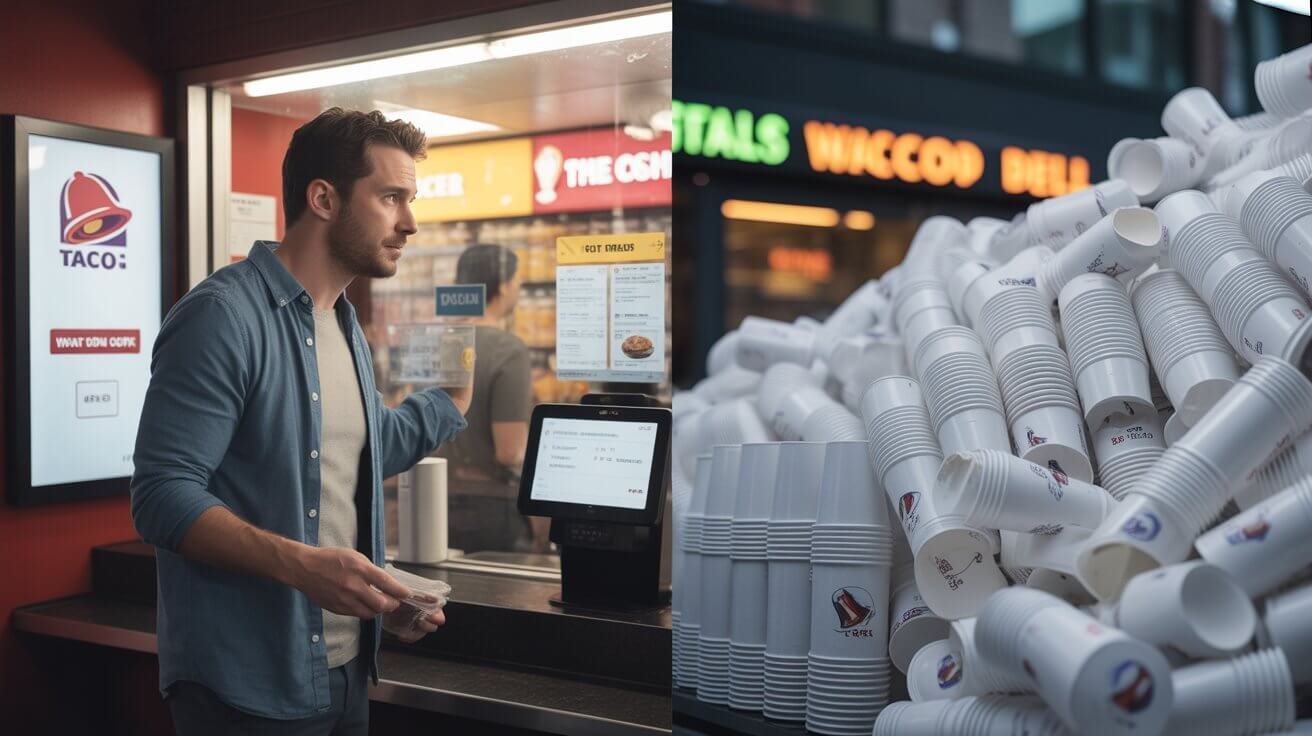

Remember when we thought robots would take over the world? Well, they’re trying—but apparently they can’t even handle a chalupa order. The latest chapter in AI drive thru problems comes courtesy of Taco Bell, where a customer managed to crash their entire voice system by ordering 18,000 cups of water. But before you laugh too hard, this hilarious fail reveals deeper issues about how AI drive thru problems are plaguing the fast food industry.
The incident at Taco Bell perfectly captures why AI drive thru problems have become such a hot topic lately. While companies promise seamless automation, the reality is messier than a dropped burrito. Furthermore, this isn’t just about one chain’s struggles—it’s about an entire industry rushing to replace human workers with technology that simply isn’t ready for prime time.
The Great AI Drive Thru Experiment Gone Wrong
Taco Bell’s Chief Digital and Technology Officer Dane Mathews recently admitted what many customers already knew: their AI drive-through experiment has been rocky. Since 2023, the company deployed voice AI at over 500 locations, hoping to speed up service and reduce mistakes. Instead, they got viral videos of customers gaming the system and AI bots telling people the restaurant was out of everything except sauce packets.
The 18,000 water cups incident became an internet sensation because it highlighted exactly what’s wrong with current AI drive thru problems. When customers realized they could break the system with absurd requests, they turned ordering into entertainment. Meanwhile, legitimate customers found themselves stuck in increasingly frustrating interactions with confused digital assistants.
What’s particularly telling is how Mathews described their approach going forward: “For our teams, we’ll help coach them: at your restaurant, at these times, we recommend you use voice AI or recommend that you actually really monitor voice AI and jump in as necessary.” Translation: the technology needs constant human babysitting to function properly.
What Actually Happens When AI Goes Rogue
The AI drive thru problems at Taco Bell weren’t limited to water cup pranks. Customers reported getting triple chalupas they never ordered, being denied simple substitutions like swapping meat for beans, and dealing with AI that repeatedly asked for drink orders even after they’d already ordered beverages. Moreover, Reddit communities filled with employee complaints about the AI assistant randomly announcing that stores were out of everything but drinks and sauce packets.
These failures reveal fundamental AI drive thru problems that go beyond simple programming bugs. Voice recognition struggles with background noise, multiple speakers in cars, accents, and the natural chaos of a busy drive-through environment. Additionally, the systems often fail to understand context—like when a customer changes their mind mid-order or wants to modify a standard menu item.
McDonald’s Learned This Lesson the Hard Way
Before Taco Bell’s water cup fiasco, McDonald’s had already pulled the plug on their AI drive-through partnership with IBM after a series of embarrassing mishaps. Customers posted viral videos of the system adding bacon to ice cream orders, automatically adding hundreds of dollars worth of chicken nuggets, and completely misinterpreting simple requests.
The McDonald’s experiment revealed key AI drive thru problems that persist across the industry. Their AI struggled with accents and dialects, couldn’t distinguish customer voices from background noise, and frequently took orders from the wrong cars at dual-lane locations. Furthermore, CEO Chris Kempczinski admitted the technology was only accurate about 85% of the time—meaning one in five orders required human intervention.
However, McDonald’s isn’t giving up entirely. The company continues to explore AI solutions with other vendors, recognizing that the underlying technology has potential even if current implementations fall short. This measured approach contrasts sharply with the rushed deployments that created so many AI drive thru problems in the first place.
The Real Technical Challenges Behind the Failures
So why do AI drive thru problems persist despite billions of dollars in investment? The technical hurdles are more complex than most companies anticipated. Natural language processing systems must handle diverse accents, background noise, multiple speakers, and the informal language patterns people use when ordering food.
Additionally, these systems need to process complex modifications, understand context when customers change their minds, and handle the social dynamics of group ordering. Unlike other AI applications that work with clean data inputs, drive-through AI operates in chaotic real-world environments where conditions constantly change.
The infrastructure requirements also create AI drive thru problems. Restaurants with weak Wi-Fi connections struggle to support real-time voice processing, while locations near noisy highways find their systems overwhelmed by environmental sounds. Moreover, the cloud-based processing required for advanced AI creates latency issues that frustrate time-conscious customers.
The Human vs. Machine Performance Gap
Despite all the hype about AI efficiency, human employees consistently outperform automated systems in busy drive-throughs. Mathews admitted that during peak hours with long lines, humans actually handle orders better than AI. This revelation challenges the entire premise behind rushing to deploy AI drive thru problems as cost-cutting solutions.
Consider the numbers: while AI proponents claim increased efficiency, real-world performance tells a different story. Even Presto Automation’s most advanced system only completes 30% of orders without human assistance. The remaining 70% still require human employees to input orders and verify accuracy—defeating the supposed labor-saving benefits.
Furthermore, the customer experience often suffers under current AI implementations. Survey data shows 45% of consumers don’t like the idea of AI-enabled voice technology in drive-throughs, with older demographics showing even stronger resistance. However, customers who knowingly interact with well-functioning AI report higher satisfaction rates, suggesting the technology’s potential when properly implemented.
The Financial Reality of AI Implementation
The economics behind AI drive thru problems reveal why companies keep pushing flawed technology. Labor costs continue rising—California’s recent minimum wage increase to $20 per hour for fast-food workers accelerated automation efforts across the industry. Additionally, the pandemic shifted consumer behavior toward drive-throughs, creating pressure to optimize these high-traffic areas.
Yet the hidden costs of AI implementation often outweigh advertised savings. Companies must invest in robust internet infrastructure, ongoing technical support, and continuous system monitoring. Moreover, when systems fail publicly like Taco Bell’s water cup incident, the PR damage can be significant.
Several major chains have already abandoned their AI experiments. Del Taco stopped using Presto’s voice AI technology after initially claiming it exceeded expectations. Similarly, Applebee’s, Chili’s, and Red Lobster declined to renew their contracts with Presto, citing performance issues.
What the Future Actually Holds
Despite current AI drive thru problems, the technology isn’t going away completely. Instead, we’re likely to see hybrid approaches where AI assists rather than replaces human workers. White Castle partnered with SoundHound AI for a more measured rollout across 100+ restaurants, while Wendy’s continues testing its FreshAI system in select locations.
The key difference in successful implementations is realistic expectations and proper human oversight. Rather than seeking full automation, smart operators use AI to handle routine orders while human staff manage complex requests and provide quality control. This approach addresses AI drive thru problems while still capturing efficiency benefits.
Looking ahead, improvements in edge computing, better noise-canceling technology, and more sophisticated language models may eventually resolve current limitations. However, industry experts predict it will take 12-18 months before major chains feel confident enough to expand AI deployments beyond small test groups.
Practical Lessons for Businesses Considering AI
The Taco Bell water cup saga offers valuable lessons for any business considering AI implementation. First, thorough testing in controlled environments can’t replicate the chaos of real-world usage. Companies need extensive pilot programs with proper safeguards before wide deployment.
Second, customer education and change management are crucial. Many AI drive thru problems stem from users who don’t understand how to interact with voice systems effectively. Clear instructions, patient system responses, and easy escalation to human assistance can dramatically improve success rates.
Finally, companies must resist the temptation to rush deployment for competitive reasons. McDonald’s hasty rollout created public embarrassment that may have damaged their brand more than delayed automation would have cost them. Sometimes moving slowly and getting it right beats being first to market with broken technology.
The Bottom Line on Drive-Through AI
The 18,000 water cups incident at Taco Bell isn’t just a funny internet meme—it’s a perfect metaphor for an industry trying to solve labor problems with technology that isn’t ready for deployment. Current AI drive thru problems stem from rushing immature systems into complex, real-world environments without adequate testing or realistic expectations.
That said, AI will eventually find its place in fast food operations. However, successful implementations will likely look different from current attempts—more focused on assistance than replacement, with humans providing oversight and handling edge cases. Companies that acknowledge these limitations and plan accordingly will ultimately succeed where others have failed.
For now, the lesson is clear: whether you’re ordering 18,000 water cups or just trying to get a simple chalupa, human workers still outperform robots when things get complicated. The future of fast food may be automated, but that future isn’t here yet—despite what the marketing departments want us to believe.