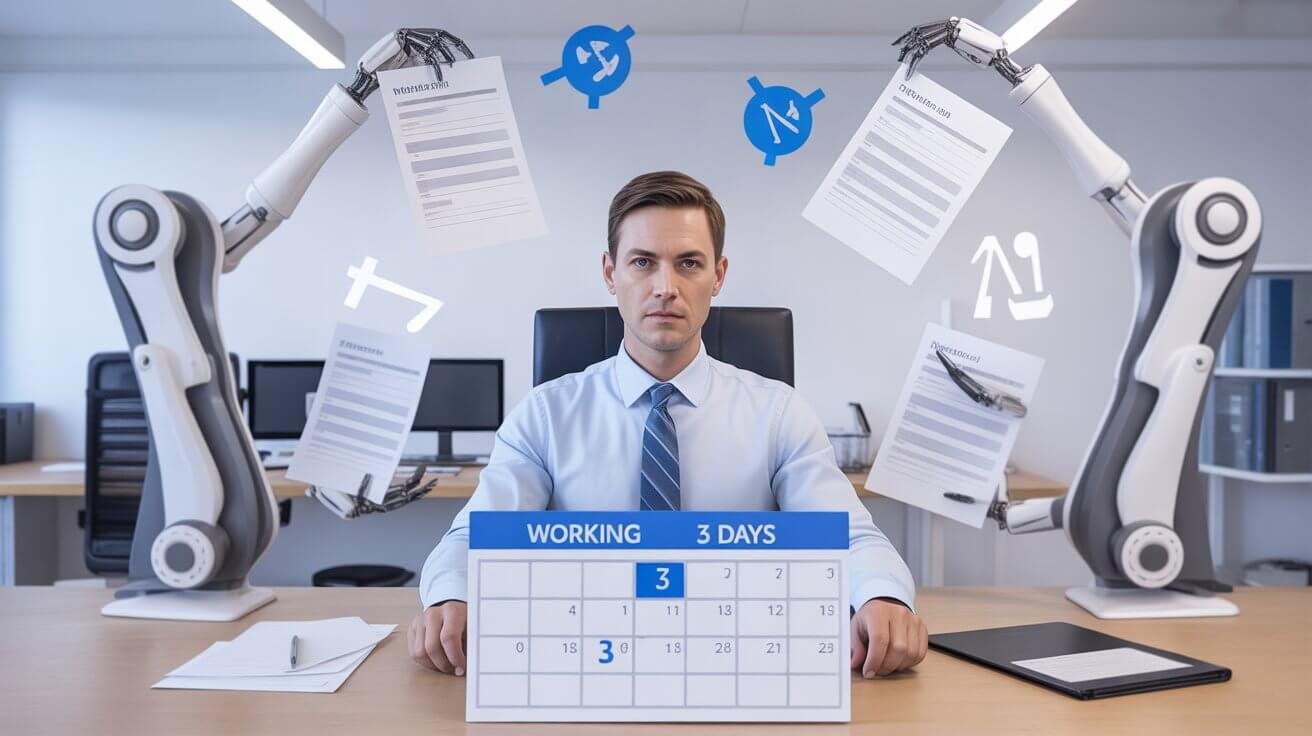

Remember when working from home sounded crazy? Now Zoom’s CEO thinks AI automation shorter workweek models will be the next big workplace revolution. Furthermore, Eric Yuan isn’t alone – tech giants like Bill Gates, Jensen Huang, and Jamie Dimon are all betting on the same future where AI automation shorter workweek arrangements become standard practice.
But here’s what’s different this time: the technology is already here, and some companies are quietly making the switch.
The AI-Powered Three-Day Revolution
Yuan recently told The New York Times something that made headlines worldwide: “I feel like if A.I. can make all of our lives better, why do we need to work for five days a week?” Consequently, he predicts that every company will eventually support three or four-day workweeks as AI takes over routine tasks.
This isn’t just wishful thinking. Additionally, Yuan acknowledged that some jobs will be erased in the process, particularly entry-level positions where AI can already write code and handle basic tasks. However, the remaining workers will enjoy dramatically reduced schedules while maintaining full productivity.
What makes this prediction compelling is the growing chorus of agreement from other industry leaders:
- Microsoft’s Bill Gates previously suggested AI’s current pace of innovation will enable two to three-day workweeks within a decade
- JPMorgan’s Jamie Dimon predicted future generations will work just 3.5 days a week
- Nvidia’s Jensen Huang sees similar automation-driven schedule reductions on the horizon
Why AI Automation Makes Shorter Workweeks Actually Work
Traditional four-day workweek experiments have shown promise, but they often struggle with one problem: how do you maintain 24/7 operations with fewer human hours? Moreover, AI automation provides the missing piece of this puzzle.
Research from MIT and Stanford shows AI can improve worker output by an average of 14%, while Goldman Sachs suggests AI could automate up to 25% of tasks currently performed by employees. These aren’t marginal gains – they represent fundamental shifts in what humans need to do at work.
Here’s how AI automation enables shorter workweeks:
Continuous Operations: Unlike humans, AI systems don’t need weekends off. Chatbots handle customer inquiries, automated workflows process requests, and predictive systems flag issues before they become problems.
Task Elimination: Rather than speeding up existing work, AI removes entire categories of tasks. For instance, scheduling, basic coding, report generation, and data analysis can now run automatically.
Enhanced Focus: With mundane tasks automated, employees spend their reduced hours on high-value activities requiring creativity, judgment, and human insight.
Real Companies Already Making the Switch
While the tech CEOs make predictions, some organizations are already living this reality. Moreover, the results are encouraging for anyone skeptical about productivity maintenance.
Roger Kirkness, CEO of software startup Convictional, recently moved his 12-person company to a four-day week without cutting pay. “Look at Fridays like weekends,” he told employees, citing AI’s ability to accelerate coding tasks as the key enabler.
Similarly, performance coaching company Exos saw remarkable results during their shorter workweek trial: employee burnout was cut in half, and productivity soared by 24%.
Game Lounge’s COO Rosi Bremec successfully implemented a four-day workweek this summer, explaining “The goal is not to replace people with AI, but to work smarter” by automating tasks like meeting minutes and report creation.
These early adopters share common strategies:
- Shorter meeting durations (25 minutes instead of an hour)
- AI-powered task tracking to manage workflow fluctuations
- Automation of administrative processes
- Focus on outcome-based rather than time-based work measurement
The Data Behind AI Automation Shorter Workweek Success
The numbers tell a compelling story about why AI automation shorter workweek models work. Research from Autonomy found that 29% of companies with 4-day work weeks are already using AI extensively, compared to only 8% of traditional five-day organizations.
McKinsey research reveals that with generative AI, automation could reduce the hours people work each day by around 30%. Furthermore, this isn’t about working faster – it’s about eliminating work entirely.
Studies consistently show that shorter workweeks deliver measurable benefits:
- 92% success rate in UK four-day workweek trials
- Improved job retention and reduced turnover costs
- Enhanced physical and mental health among participants
- Lower operational costs from reduced facility usage
Additionally, Future Forum research discovered that 93% of leaders at high-AI-usage companies were open to a four-day workweek, compared to fewer than half of those with minimal AI integration.
What This Means for Different Types of Workers
The AI automation shorter workweek transition won’t affect everyone equally. Therefore, understanding where you fit helps determine your future prospects.
Knowledge Workers: Those in creative, strategic, or relationship-focused roles will likely benefit most. AI handles research, drafting, and analysis while humans focus on decision-making and innovation.
Entry-Level Positions: Unfortunately, Yuan acknowledges these face the highest risk. “For some jobs, like entry-level engineers, we can use A.I. to write code. However, you still need to manage that code”, he explains.
Management Roles: New opportunities emerge in AI oversight and digital agent management. Companies will need humans to coordinate between AI systems and handle complex problem-solving.
Customer-Facing Roles: While AI handles routine inquiries, human workers focus on complex customer relationships and situations requiring empathy and nuanced judgment.
Practical Steps to Prepare for the Shorter Workweek Future
Smart professionals are already positioning themselves for this transition. Consequently, here are actionable steps to take now:
Develop AI Collaboration Skills: Learn to work alongside AI tools rather than compete with them. Practice using AI for research, brainstorming, and task automation while maintaining human oversight.
Focus on Uniquely Human Capabilities: Strengthen skills that AI can’t replicate – emotional intelligence, creative problem-solving, complex relationship management, and strategic thinking.
Embrace Outcome-Based Work: Start measuring your contribution by results rather than hours. Build a track record of delivering value efficiently.
Stay Learning-Ready: As Yuan advises, “Laser-focus on what you are doing every day. Try to get a good grade and enjoy campus life. At the same time, learn a little bit of AI. Mentally, get yourself ready, gradually”.
The Timeline: How Soon Will This Actually Happen?
Industry predictions vary, but the consensus points to significant changes within this decade. Moreover, Gates suggests two to three-day workweeks could arrive within 10 years, while Yuan sees three to four-day schedules happening “very soon.”
The acceleration factors include:
- Rapid AI capability improvements
- Growing employee demand for work-life balance
- Competitive pressure as early adopters demonstrate success
- Economic incentives from reduced operational costs
However, implementation won’t be uniform. Small companies can pivot faster, while large corporations will need time to restructure operations. Additionally, regulatory environments and cultural attitudes will vary by region.
The Challenges We Still Need to Solve
Despite the promising outlook, significant obstacles remain before AI automation shorter workweek models become mainstream.
Economic Concerns: Will companies maintain full salaries for reduced hours, or will this lead to proportional pay cuts? The answer likely depends on productivity gains and competitive labor markets.
Skills Gap Management: As Yuan worries, “Sometimes I’m extremely concerned” about young people finding jobs in an AI-dominant market. Society needs robust retraining programs.
Inequality Risks: Without careful implementation, AI automation could create a two-tier system where some workers enjoy shorter hours while others face unemployment or precarious gig work.
Cultural Resistance: Many organizations still equate hours worked with value created. This mindset shift may prove harder than the technical implementation.
Looking Forward: What the AI-Powered Workweek Really Means
The conversation about AI automation shorter workweek isn’t really about technology – it’s about reimagining work itself. Furthermore, as Yuan points out, this represents another paradigm shift similar to the industrial revolution and internet adoption.
The most successful organizations will be those that view AI not as a cost-cutting tool, but as an opportunity to create better working conditions while maintaining competitive advantage. Additionally, workers who adapt early and learn to collaborate with AI systems will find themselves in high demand.
What excites me most about this future is the potential for work to become more human. When AI handles the routine tasks, people can focus on creativity, relationship-building, and solving complex problems that require judgment and empathy.
The three-day workweek might sound impossible today, but so did remote work just a few years ago. With AI automation advancing rapidly and early adopters proving the concept works, we might be closer to this future than we think.
The question isn’t whether AI automation shorter workweek models will emerge – it’s whether your organization will be ready to embrace them.
Meta Description: Discover how AI automation shorter workweek models are becoming reality. Tech CEOs predict 3-day workweeks as AI transforms productivity and job structures.