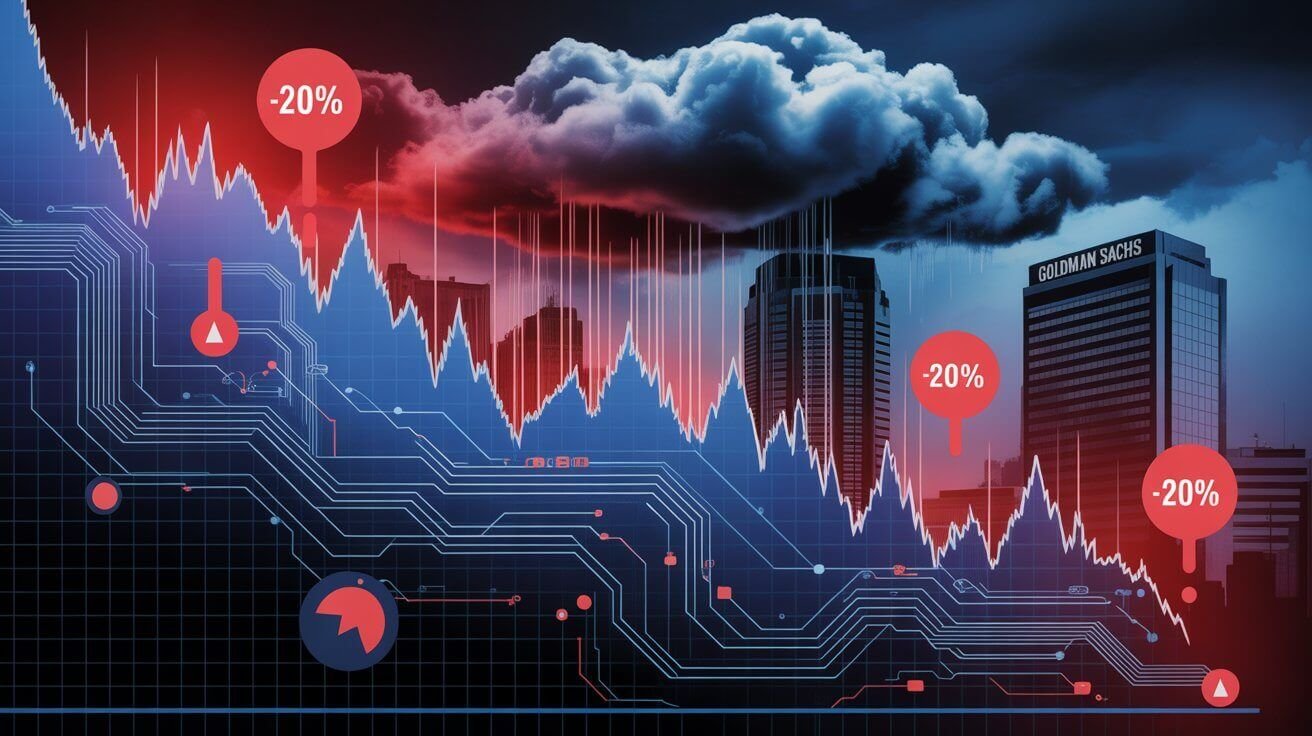

AI market correction risks are keeping investors awake at night, and frankly, they should be. Goldman Sachs just delivered a sobering reality check: when the inevitable slowdown in AI spending hits, we could see the S&P 500’s valuation tumble by up to 20%. Moreover, this AI market correction wouldn’t just be a minor hiccup—it could reshape the entire tech landscape.
I’ve been tracking this story closely, and the numbers are staggering. Big Tech companies have thrown $368 billion at AI infrastructure in 2025 alone, yet signs point to trouble ahead.
The Numbers That Should Worry Every Investor
Here’s what’s really happening behind the scenes. Goldman estimates that hyperscaler capex has totaled $368 billion so far this year, with companies like Microsoft, Amazon, Google, and Meta leading the charge. However, these massive expenditures aren’t guaranteed to continue forever.
The investment bank warns that if hyperscalers cut their capital spending back to 2022 levels, the “lost” revenues to AI companies would represent a 30% cut to Goldman’s estimate of $1 trillion in projected S&P 500 sales growth for 2026. That’s not just a speed bump—that’s a potential market earthquake.
What makes this particularly concerning is the concentration risk. The top five tech stocks now account for nearly 40% of the S&P 500’s market capitalization. When a handful of companies control such a massive chunk of the market, their problems become everyone’s problems.
Microsoft alone plans to spend $120 billion in 2025, while Amazon, Google, and Meta combined are throwing over $300 billion at AI infrastructure. But analysts are already spotting cracks in the foundation.
When Reality Meets Hype: The Warning Signs
I’ve seen this movie before, and it doesn’t end well. Furthermore, the current situation has eerie similarities to previous tech bubbles, though with some crucial differences.
Valuations are high, but they are actually lower than they were in the dotcom boom of 2000, Goldman says. That’s the good news. The concerning part? Analysts currently assume a sharp deceleration in 4Q 2025 and 2026 for hyperscaler spending.
But here’s the kicker—companies keep pushing those spending cuts further into the future. Every quarter, they revise their capital expenditure guidance upward, creating a feedback loop that can’t last forever.
OpenAI, the poster child of the AI boom, exemplifies this disconnect between investment and returns. Despite all the hype, the company expects to lose $14 billion by 2026, even according to its own optimistic projections. Meanwhile, they’re asking investors to ignore training costs when calculating profitability—a creative accounting approach that should raise red flags.
The Infrastructure Overload Problem
The hyperscalers are essentially in an arms race, each trying to build the biggest, most capable AI infrastructure. Amazon Web Services projects $100 billion in capital expenditures, Google plans $85 billion, and Microsoft isn’t far behind at $80 billion.
This creates several risks that smart investors should consider:
- Overcapacity: Data centers are being built faster than demand can realistically grow
- Margin compression: Intense competition is driving down pricing power
- Technology obsolescence: Rapid AI advancement could make today’s infrastructure investments worthless
Phase 3 Reality Check: Where the Money Actually Flows
However, the real test comes when we move beyond infrastructure spending to actual revenue generation. Goldman Sachs talks about “Phase 3” companies—those that will supposedly benefit from AI’s ripple effects throughout the economy.
The problem? Investors will likely require evidence of a tangible near-term impact on earnings before embracing these stocks. So far, that evidence remains frustratingly elusive for most companies outside the core AI infrastructure players.
Therefore, we’re looking at a market where speculation has run far ahead of actual business results. Companies are spending unprecedented amounts on AI capabilities, but the promised productivity gains and revenue boosts haven’t materialized at scale.
Consider this sobering statistic: despite AI investments reaching historic levels, overall business productivity growth remains stubbornly low. That disconnect can’t persist indefinitely without triggering an AI market correction.
The Hyperscaler Spending Timeline
Current analyst expectations point to a spending slowdown beginning in late 2025 or 2026. Nevertheless, hyperscalers keep revising their guidance upward, suggesting the timeline might slip further.
This creates a dangerous dynamic where the market keeps expecting growth that may not materialize when companies finally start cutting back. When that shift happens, the AI market correction risks becoming very real very quickly.
Smart Strategies for Portfolio Protection
So how should investors position themselves for this potential AI market correction? Based on my research and analysis, here are several practical approaches:
Diversification is crucial right now. Don’t let AI enthusiasm concentrated in a few mega-cap stocks dominate your portfolio. Goldman Sachs recommends overweighting sectors like utilities, materials, and real estate that are less dependent on AI hype.
Monitor capex trends closely. Watch quarterly earnings calls for signs that hyperscalers are becoming more cautious about their AI spending. Early indicators could give you a head start on positioning changes.
Focus on companies with proven AI revenue streams. Look beyond infrastructure players to find businesses that are already generating real income from AI applications, not just spending money on potential future capabilities.
Consider defensive positions. Companies with floating-rate debt could benefit as interest rates decline, while alternative asset managers might outperform if traditional tech growth slows.
Additionally, keep an eye on the broader market breadth indicators. The median stock within the index is more than 10% below its 52-week high, suggesting the current rally is narrower than it appears.
The Long-Term Outlook: Beyond the Correction
Despite these AI market correction risks, this doesn’t mean AI technology itself is doomed. Rather, we’re likely seeing a natural maturation process where unrealistic expectations meet economic reality.
Historically, transformative technologies go through cycles of hype, disappointment, and eventual stable growth. The internet survived the dot-com crash and eventually delivered on its promises—just not as quickly or as dramatically as initially expected.
Similarly, AI will probably prove transformative over the long term. However, the current valuation levels and spending patterns suggest we need a reset before sustainable growth can resume.
The key insight? A 20% capex slowdown by 2026 could slash S&P 500 valuations by 15-20%, but this correction might actually set the stage for healthier, more sustainable AI adoption across the economy.
Smart investors should prepare for short-term volatility while maintaining a long-term perspective on AI’s genuine potential.
Conclusion: Preparing for the Inevitable
AI market correction risks aren’t a matter of if, but when. Goldman Sachs has laid out a clear scenario where hyperscaler spending slowdowns could trigger significant market disruption, potentially slashing S&P 500 valuations by up to 20%.
The warning signs are already visible: massive infrastructure spending without proportional revenue growth, concentration risk in mega-cap tech stocks, and unrealistic expectations about AI monetization timelines. Furthermore, with hyperscalers planning to spend over $350 billion in 2025 alone, the potential for overcapacity and margin compression grows daily.
Nevertheless, this doesn’t mean you should panic or abandon tech investments entirely. Instead, use this knowledge to build a more resilient portfolio that can weather the coming AI market correction while positioning for long-term opportunities.
The companies that survive this shakeout will likely be those with genuine business models, proven revenue streams, and realistic approaches to AI implementation. By focusing on these fundamentals rather than hype, you can protect your investments and potentially profit from the inevitable market reset that’s coming.