
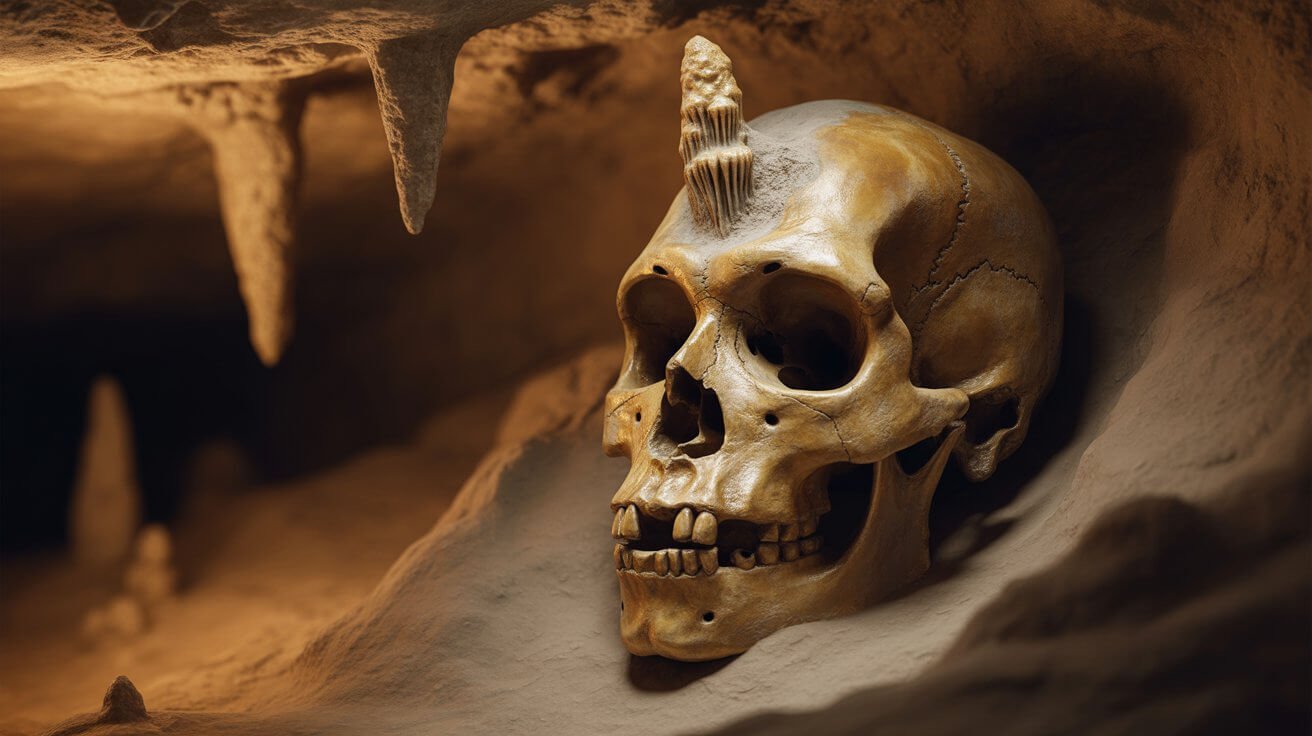

Picture this: You’re exploring a cave in northern Greece, and suddenly you spot something incredible—a human skull fused to the cave wall by mineral deposits, with what looks like a stalagmite growing out of its forehead. That’s exactly what happened in 1960, when a local villager stumbled upon what would become one of the most puzzling fossils in human evolution. The Petralona skull human evolution story has captivated scientists for decades, and recent research is finally providing answers that challenge everything we thought we knew about our ancient relatives.
This remarkable discovery involves not just one, but several mysterious skulls found in Greek caves that are forcing experts to reconsider the timeline and complexity of Petralona skull human evolution. Furthermore, these findings suggest that Europe’s ancient human landscape was far more diverse than previously imagined.
The Petralona Skull Human Evolution Discovery That Started It All
The Petralona Cave Human Evolution Find
Back in 1960, Christos Sariannidis was exploring Petralona Cave in northern Greece when he made an extraordinary discovery. The skull wasn’t just lying on the ground—it was actually stuck to the cave wall, held in place by calcite deposits that had formed over thousands of years.
What makes this discovery so fascinating isn’t just where it was found, but what it represents. The Petralona skull human evolution implications became clear once scientists realized this wasn’t your typical ancient human remains. Recent studies have dated the skull to approximately 300,000 years old, and concluded that it belonged to neither modern humans nor Neanderthals.
Scientists describe the skull as having a mixture of primitive and advanced features. Moreover, the preservation was remarkable—the mineral deposits that encrusted the skull also helped protect it from damage over the millennia.
A Second Human Evolution Shocking Discovery
Greece’s contribution to Petralona skull human evolution research didn’t stop there. In the late 1970s, researchers discovered two more ancient skull fragments in Apidima Cave in southern Greece. These finds, known as Apidima 1 and Apidima 2, added another layer of mystery to the story.
The plot twist? Apidima 1 dates to more than 210,000 years old and shows characteristics that some researchers believe indicate it belonged to Homo sapiens—potentially making it the oldest evidence of modern humans in Europe. Consequently, this discovery suggests our ancestors may have ventured out of Africa much earlier than previously thought.
What Makes These Human Evolution Skulls So Special?
Neither Human Nor Neanderthal: Petralona Evolution Evidence
The Petralona skull human evolution mystery deepens when you examine what these fossils actually represent. The Petralona specimen forms part of a distinct and more primitive group than both Homo sapiens and Neanderthals, suggesting the presence of a previously unknown human lineage in ancient Europe.
Think about it—we’ve long assumed that Europe was primarily inhabited by Neanderthals before modern humans arrived around 40,000-50,000 years ago. However, these Greek discoveries paint a completely different picture. They suggest that multiple human groups were living in Europe simultaneously, each with their own unique characteristics.
The skull’s features are particularly intriguing because they show a blend of primitive and more advanced traits. Additionally, the robustness of the skull suggests it likely belonged to a young adult male who lived in challenging environments.
Advanced Dating Techniques Reveal Human Evolution Surprises
Recent technological advances have allowed scientists to date these specimens with unprecedented precision. Using uranium-series dating on the calcite deposits, researchers established that the Petralona skull is at least 286,000 years old.
This dating method works because uranium in the calcite deposits decays into thorium at a predictable rate. Consequently, scientists can calculate ages based on the ratio of these elements in the mineral deposits that formed around the skull.
The Petralona Skull Human Evolution Implications
Challenging the Linear Human Evolution Timeline
The Petralona skull human evolution findings are forcing scientists to abandon the idea of a simple, linear progression from one human species to another. Instead, we’re seeing evidence of a much more complex web of human populations living simultaneously across different regions.
Traditional models suggested that human evolution followed a straightforward path: Homo erectus led to archaic humans, who eventually became modern Homo sapiens and Neanderthals. But these Greek discoveries indicate that reality was far messier and more interesting.
Multiple human lineages appear to have coexisted in Europe during the Middle Pleistocene period (roughly 700,000 to 130,000 years ago). Therefore, our understanding of human evolution needs to account for this increased complexity.
Europe as a Human Evolution Crossroads
Southeast Europe, positioned at the crossroads of Africa, Asia, and Europe, likely served as a corridor for multiple human migrations. This geographic positioning helps explain why Greece has yielded such diverse human fossils.
The region’s relatively mild climate during glacial periods also made it an attractive refuge for ancient human populations. As a result, multiple groups could have survived and thrived there while other parts of Europe were covered in ice.
The Ongoing Petralona Skull Scientific Debate
Competing Human Evolution Theories
Not all scientists agree on what these skulls represent. Some researchers argue that both Apidima skulls should be attributed to evolved European Homo erectus with early Neanderthal features, rather than representing separate species or early modern humans.
This disagreement highlights the challenges of interpreting fragmentary fossil evidence. Since we’re often working with incomplete skulls that have been damaged by time and geological processes, drawing definitive conclusions can be difficult.
Nevertheless, the Petralona skull human evolution debate continues to generate new insights and research directions. Each new analysis adds another piece to the puzzle of human origins.
The Evolution Research Technology Factor
Modern virtual reconstruction techniques have revolutionized how we study ancient skulls. Scientists can now digitally repair damage and create mirror images of partial fossils to better understand their original form.
These technological advances mean that fossils sitting in collections for decades can suddenly yield new information. Furthermore, improved dating methods continue to refine our understanding of when these ancient humans lived.
What This Means for Our Understanding of Petralona Human Evolution Origins
A More Complex Human Evolution Family Tree
The Petralona skull human evolution discoveries suggest that our family tree resembles a bush with multiple branches rather than a simple ladder. Different human populations evolved simultaneously, sometimes interacting and sometimes developing in isolation.
This complexity makes human evolution far more interesting than the old “march of progress” narrative suggested. Instead of a single line of development, we see evidence of experimentation, adaptation, and diversification across different environments and time periods.
Human Evolution Implications for the “Out of Africa” Theory
While these discoveries don’t overturn the fundamental “Out of Africa” model, they do suggest that human migrations out of Africa occurred earlier and more frequently than previously thought. The findings support multiple dispersals of early modern humans out of Africa.
This means that the story of human expansion is more dynamic and complex than we once imagined. Rather than a single great migration, there may have been multiple waves of human populations moving between continents over hundreds of thousands of years.
Looking to the Future of Petralona Skull Research
What Comes Next in Human Evolution Research?
The Petralona skull human evolution story is far from over. Researchers continue to analyze these fossils using increasingly sophisticated techniques, and new discoveries in Greek caves may yet surprise us.
Ancient DNA analysis, when possible, could provide definitive answers about the relationships between these ancient populations and modern humans. However, DNA preservation becomes increasingly unlikely in fossils this old, especially in Mediterranean climates.
Advanced imaging techniques and chemical analysis of the fossils themselves may reveal new information about the lives and environments of these ancient humans. For instance, isotope analysis of teeth can provide insights into diet and migration patterns.
The Broader Human Evolution Picture
These Greek discoveries remind us that human evolution is an ongoing detective story. Each new fossil discovery has the potential to reshape our understanding of who we are and where we came from.
The Petralona skull human evolution research demonstrates the importance of continued archaeological investigation, especially in regions like southeastern Europe that have been understudied compared to Africa.
As technology advances and new sites are discovered, we can expect more surprises that will continue to refine and complicate our understanding of human origins. The Greek cave skulls have already shown us that ancient Europe was far more diverse than we imagined—what other secrets might be waiting to be uncovered?
Conclusion
The mysterious skulls found in Greek caves have fundamentally changed our understanding of European prehistory. These aren’t just old bones—they’re time capsules that reveal a complex story of multiple human populations adapting, surviving, and evolving in ancient Europe.
The Petralona skull human evolution discoveries challenge us to think beyond simple linear narratives about human development. Instead, they point toward a richer, more complex story of our species’ past—one where different human groups coexisted, adapted to various environments, and contributed to the diverse tapestry of human evolution.
These findings remind us that science is an ongoing conversation, not a collection of fixed facts. As new discoveries emerge and technology advances, our understanding of human origins continues to evolve. The Greek cave skulls have given us a fascinating glimpse into this complex past, and they undoubtedly have more secrets yet to reveal.