
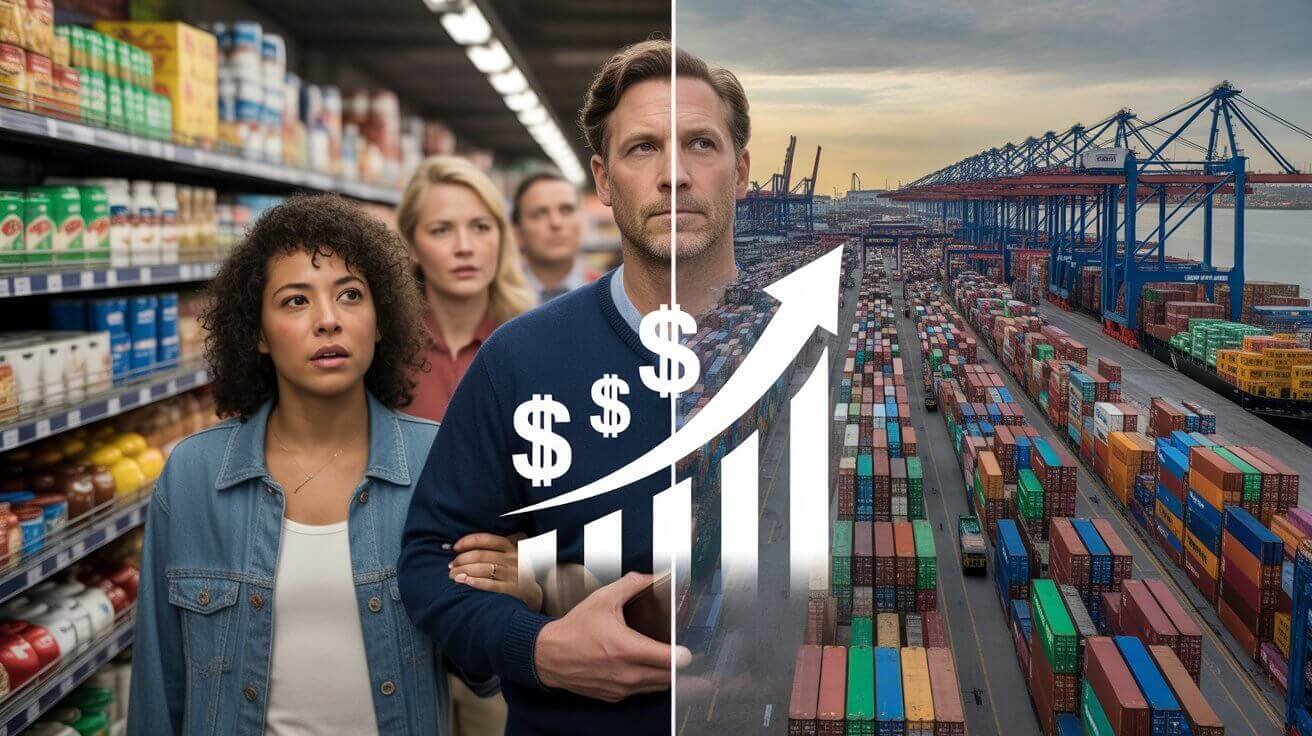

Remember when you used to complain about paying $4 for coffee? Well, brace yourself. The Trump tariffs consumer impact is starting to hit American households in ways that most people haven’t fully realized yet. While politicians debate trade policy in Washington, families across the country are slowly watching their purchasing power erode.
The Trump tariffs consumer impact isn’t just about economics—it’s about your daily life. Through June, US consumers had absorbed 22% of tariff costs, but Goldman Sachs economists estimate that share will rise to 67% by October. Meanwhile, these massive trade barriers represent the largest tax hike since 1993, increasing federal tax revenues by $172.1 billion in 2025.
The Trump Tariffs Consumer Impact: A Hidden Tax You Never Voted For
Here’s something most people don’t understand: tariffs aren’t paid by foreign countries. They’re essentially a tax on imports that American companies pay at the border. And guess who ultimately foots that bill? Yep—you and me.
The tariffs amount to an average tax increase of nearly $1,300 per US household in 2025. But if you’re a middle-income family, the news gets worse. Penn Wharton Budget Model projects that a middle-income household faces a $58,000 lifetime loss from these tariffs.
Think about that for a second. That’s like losing a year’s worth of income over your lifetime, just because of trade policy decisions you had no say in.
Consumer Impact: What’s Actually Getting More Expensive
The Trump tariffs consumer impact shows up in surprising places. Computer and electronic prices could rise by 17% in the short run and 7.7% in the long run, according to Yale Budget Lab economists. But it’s not just tech gadgets—we’re talking about everything from:
- Groceries: Mexican avocados and limes are getting pricier
- Cars: Analysts estimate tariffs could add up to $3,000 to vehicle prices
- Home appliances: Appliance prices jumped 1.9% in June, the highest monthly increase since August 2020
- Clothing: Especially basic items like T-shirts and sneakers
- Gas: Gas prices could surge as much as 50 cents per gallon in the Midwest
Why Trump Tariffs Consumer Impact Haven’t Hit You Yet
You might be thinking, “But my grocery bills haven’t doubled!” That’s true, and there’s actually a fascinating reason why. Companies have been playing defense in three key ways:
First, they stockpiled like crazy. Many retailers began stockpiling goods as early as last winter to avoid new import taxes. However, Goldman Sachs noted that larger retailers were carrying about three months’ worth of extra inventory, meaning they’re eventually going to run out.
Second, businesses are eating costs—for now. Bobby Djavaheri, whose company imports air fryers from China, said “I think we raised [prices] about 10% and absorbed the rest. It’s simply impossible to pass on all of it because folks aren’t going to buy the product”.
Third, the global supply chain is complicated. Companies are scrambling to find alternative suppliers, renegotiate contracts, and restructure their operations. But that takes time.
How Businesses Are Absorbing Tariff Impact (For Now)
Behind the scenes, American companies are struggling with these new costs. Apple faced $800 million in tariff-related costs last quarter alone and expects that to rise to $1.1 billion this quarter. General Motors said tariffs cost the company about $1.1 billion in the previous quarter.
Major retailers including Walmart, Best Buy, Nike, and Procter & Gamble have all raised prices due to tariff pressures. As Capital Economics analysts noted, “We doubt that is a sustainable outcome over the longer term. As the uncertainty over tariff levels eases, we would expect more firms to raise prices”.
The Trump tariffs consumer impact becomes more severe as companies run out of wiggle room. Eventually, those absorbed costs have to go somewhere—and that somewhere is your wallet.
Consumer Tariff Effects: The Ripple Effect Nobody Talks About
Moreover, tariffs don’t just make imports expensive—they give domestic producers permission to raise their own prices. When foreign competitors cost more, American companies can charge more too. Goldman Sachs economists expect that about 70% of direct tariff costs will eventually fall on consumers, potentially rising to 100% when including spillover effects of domestic producers raising prices.
Trump Tariffs Impact on Global Trade Relations
The international response has been swift and predictable. Countries aren’t just sitting back and accepting these tariffs. One thing about global trade wars is that they do tend to spread. Protectionism from the U.S. will eventually beget protectionism elsewhere.
Canada has been slapped with a 35% tariff rate, while Switzerland faces 39%, and Taiwan faces 20%. European officials have suggested retaliatory measures, and other countries are actively seeking alternative markets for their goods.
This creates what economists call a “beggar-thy-neighbor” scenario, where everyone tries to protect their own economy at the expense of others. Historically, this approach rarely ends well for anyone.
Consumer Impact: What This Means for Your Future
Unfortunately, the long-term Trump tariffs consumer impact looks challenging. The Peterson Institute estimates tariffs significantly reduce US and global economic growth and increase inflation in many economies. The Penn Wharton Budget Model projects Trump’s tariffs would reduce GDP by about 8% and wages by 7%.
Furthermore, a February 2025 analysis by the Budget Lab at Yale found that matching other countries’ tariff rates would result in U.S. consumers seeing price levels rise by 1.7 to 2.1 percent. And guess what? Price increases will hit lower-income people the hardest.
Tariff Impact on Jobs: The Market Paradox
Here’s where things get really interesting: these tariffs were supposedly designed to protect American jobs. But the reality is more complicated. Given that so many U.S. manufacturers rely on imported materials or component parts, the administration’s actions will likely make U.S. producers less competitive given their higher operating costs.
When American manufacturers have to pay more for raw materials and components, they become less competitive globally. This can actually lead to job losses rather than job gains.
The Legal Drama You Should Know About
There’s been a fascinating legal twist in this story. The Court for International Trade has ruled that tariffs imposed under the International Emergency Economic Powers Act (IEEPA) are unlawful. However, the tariffs remain in effect while the case is on appeal.
If these court challenges succeed, the effective tariff rate would fall from 13-14% to roughly 5%, which could materially upgrade growth forecasts and reduce inflation by close to a percentage point.
How to Handle Trump Tariffs Consumer Impact: What You Can Do
So what’s a regular person supposed to do with this information? First, understand that despite political promises, you can’t easily avoid the Trump tariffs consumer impact. “Buying American” won’t help much because American producers will raise their prices to nearly match their competitors.
That said, here are some practical steps:
- Budget for higher prices on electronics, appliances, and imported goods
- Consider timing major purchases if you’ve been planning them anyway
- Don’t panic-buy or stockpile—that can create artificial shortages
- Stay informed about which products might be affected next
The Bottom Line
The Trump tariffs consumer impact represents one of the most significant shifts in American trade policy in decades. While the full effects are still unfolding, the evidence clearly shows that American consumers and businesses—not foreign countries—are bearing the cost.
As Harvard Business School’s Alberto Cavallo noted, “I think it could take over a year for us to see some of the effects of these tariffs. But a year from now, maybe two years from now, we’ll notice that consumers ended up paying a significant amount of the tariffs even if they didn’t notice the increases right away”.
The Trump tariffs consumer impact isn’t just an economic issue—it’s reshaping how Americans shop, what they buy, and how much they pay for everyday goods. Whether you support or oppose these policies, the reality is that your wallet will likely feel the effects for years to come. The question isn’t whether these costs will hit consumers, but when and how much we’ll all end up paying.