
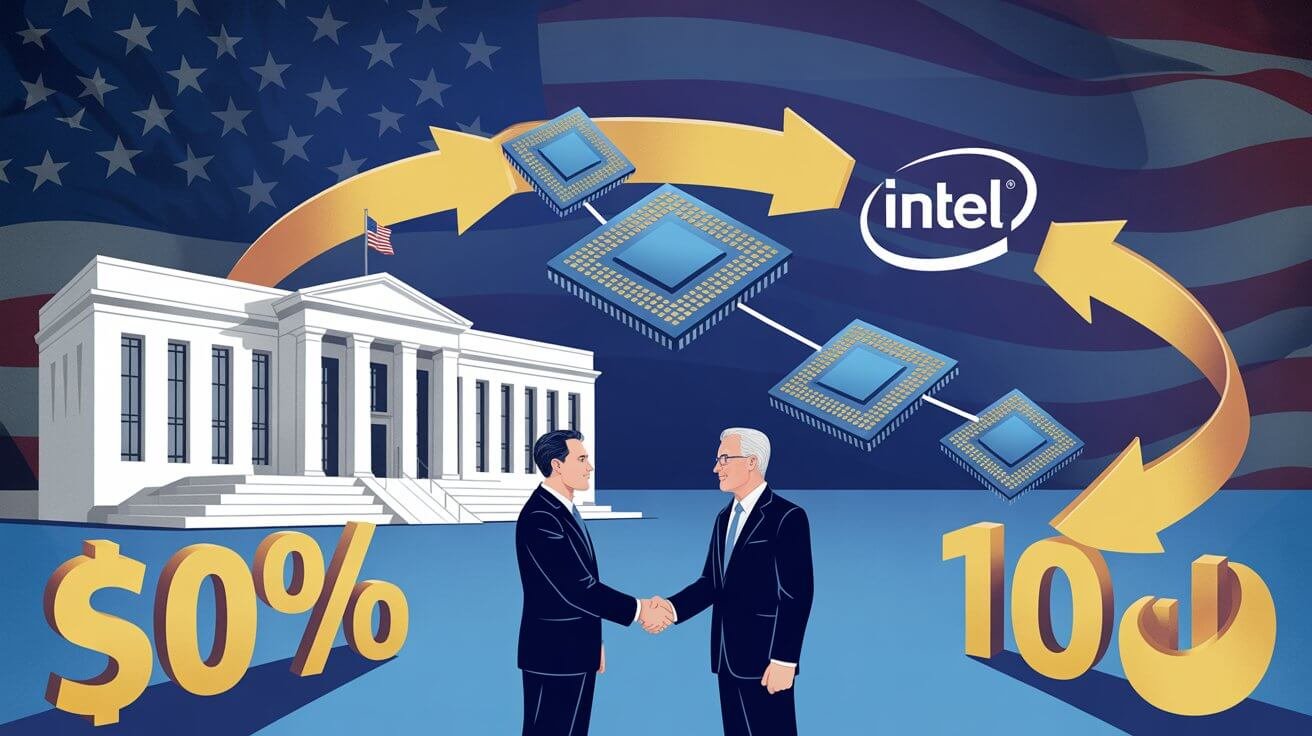

Something unprecedented just happened in American business. The United States government now owns 10% of Intel, marking the Trump administration’s most extraordinary intervention into private sector operations. This groundbreaking federal equity investment represents a seismic shift from decades of hands-off economic policy – and it’s sending shockwaves through Silicon Valley.
But what exactly does this mean for America’s tech industry? Moreover, how did we get to a point where the federal government is essentially becoming a venture capitalist?
The $8.9 Billion Federal Equity Investment: What Actually Happened?
Intel announced that the government made an $8.9 billion investment in Intel common stock, purchasing 433.3 million shares at a price of $20.47 per share, giving it a 10% stake in the company. However, this wasn’t a traditional cash transaction.
The clever twist here is how Trump’s team structured this federal equity investment. The government is purchasing the shares with funding from $5.7 billion in unpaid CHIPS Act grants and $3.2 billion awarded to Intel for the Secure Enclave program. Essentially, they converted promised grants into actual ownership stakes.
This means the American taxpayer just became Intel’s largest shareholder without writing a single new check.
Why Intel? Strategic Government Investment Behind the Move
Intel wasn’t chosen randomly for this historic federal equity investment. The chipmaker has been struggling to compete with rivals like Nvidia in the artificial intelligence boom, making it a perfect candidate for government intervention.
Intel’s revenue has fallen in recent years, driving its market capitalization down. Meanwhile, competitors have thrived in the AI chip market that now powers everything from ChatGPT to autonomous vehicles.
But here’s what makes this fascinating: Intel remains “the only American company capable of making advanced chips on U.S. soil.” That’s a national security goldmine in an era where semiconductor supply chains determine global power.
Commerce Secretary Howard Lutnick put it bluntly: “The Biden administration literally was giving Intel for free… Donald Trump turns that into saying, ‘Hey, we want equity for the money. If we’re going to give you the money, we want a piece of the action.'”
The Limits of Government Equity Stakes: What 10% Actually Gets You
Don’t expect Uncle Sam to start showing up at Intel board meetings anytime soon. The government’s investment in Intel will be a passive ownership, with no Board representation or other governance or information rights.
This federal equity investment comes with significant restrictions:
- No voting rights on major corporate decisions
- No board representation
- Agreement to vote with Intel’s current board on shareholder matters
- Limited exceptions for certain governance issues
Think of it more like a silent partner with deep pockets rather than an active business partner. The government gets financial upside without operational headaches.
From CHIPS Act to Government Equity: The Policy Evolution
The transformation from grants to federal equity investment didn’t happen overnight. It represents a fundamental shift in how America approaches industrial policy.
Under the Biden administration’s CHIPS Act, companies like Intel received billions in grants with no strings attached beyond building domestic manufacturing capacity. Trump’s approach flips this model entirely.
“We should get an equity stake for our money,” Commerce Secretary Howard Lutnick explained. “So we’ll deliver the money, which was already committed under the Biden administration. We’ll get equity in return for it.”
This federal equity investment strategy could extend beyond Intel. Trump has already secured similar arrangements with Nvidia and AMD, requiring them to pay 15% of their China revenues to the U.S. government in exchange for export licenses.
The National Security Angle: Why Semiconductors Matter
Semiconductors power everything from smartphones to military defense systems. Currently, most advanced chip manufacturing happens in Taiwan and South Korea – regions that could become inaccessible during geopolitical conflicts.
Intel’s domestic manufacturing capabilities make it strategically invaluable. The company is building new fabrication facilities in Ohio, dubbed the “Silicon Heartland,” where it plans to manufacture cutting-edge processors entirely on American soil.
However, Intel has struggled to attract major customers to these new facilities. The federal equity investment provides breathing room and credibility that could help secure those crucial partnerships.
Wall Street Reacts: Market Impact of Federal Investment
Intel’s stock jumped 5.5% immediately after Trump’s announcement, suggesting investors welcome government backing. The market sees this federal equity investment as validation of Intel’s turnaround potential.
But there’s a catch. The government purchased shares at $20.47 each – a discount from Friday’s closing price of $24.80. This means taxpayers already have a paper gain of about $1.9 billion on their investment.
SoftBank’s simultaneous $2 billion investment adds another layer of credibility. When Japan’s biggest tech investor backs your play alongside the U.S. government, people pay attention.
Practical Examples: Federal Equity Investment Impact on Americans
This federal equity investment isn’t just about corporate balance sheets – it has real-world implications:
Job Creation: Intel’s domestic expansion will create thousands of high-paying manufacturing jobs in Ohio and other states where new facilities are planned.
Supply Chain Security: American-made chips reduce dependence on foreign suppliers, potentially stabilizing prices for electronics consumers rely on daily.
Technology Leadership: Government backing helps Intel compete with foreign rivals who receive massive state subsidies from their home countries.
Tax Revenue: If Intel succeeds, government ownership means taxpayers directly benefit from the company’s profits through dividends and eventual stock appreciation.
Future Implications: The New Era of Government Investment Capital
Trump’s federal equity investment approach signals a dramatic departure from traditional free-market policies. Instead of simply providing grants or loans, the government is becoming an active investor in critical industries.
This model could expand to other sectors deemed essential for national security:
- Rare earth mineral extraction companies
- Defense technology startups
- Energy storage manufacturers
- Advanced manufacturing firms
Critics worry this creates “corporate risk” by blurring lines between public and private sectors. Supporters argue it’s necessary to compete with China’s state-directed capitalism.
The precedent is now set. Future administrations will likely face pressure to pursue similar federal equity investment strategies in other strategically important companies.
Lessons from History: When Federal Investment Became Equity
This isn’t America’s first experiment with government ownership of private companies. During the 2008 financial crisis, the government took significant stakes in General Motors, AIG, and major banks to prevent economic collapse.
However, those interventions occurred during emergency circumstances. Trump’s federal equity investment in Intel happens during relatively stable economic times, making it more controversial.
The key difference? Previous government investments aimed to prevent corporate failures. This investment aims to accelerate American technological leadership.
The Bottom Line: A New Chapter in American Industrial Policy
Trump’s Intel deal represents more than a single transaction – it’s a blueprint for how America might compete in the 21st century’s technology race. By converting grants into federal equity investment, the government gains financial upside while supporting strategic industries.
Whether this approach succeeds depends on Intel’s ability to execute its turnaround plan. If the company captures more market share in AI chips and attracts customers to its new factories, taxpayers could see substantial returns on their involuntary investment.
But if Intel continues struggling against nimbler competitors like Nvidia, American taxpayers might end up holding shares in a declining company.
Time will tell whether Trump’s federal equity investment strategy represents brilliant economic statecraft or expensive government overreach. What’s certain is that the relationship between Washington and Silicon Valley has fundamentally changed.
The era of no-strings-attached government funding is over. In its place, we’re entering an age where Uncle Sam wants his piece of the action.