

Picture this: you’re biting into a juicy burger that tastes exactly like beef, but no cow was ever harmed. Moreover, this burger required 99% less land and 96% less water to produce than traditional meat. This isn’t science fiction—it’s synthetic meat, and it’s happening right now in laboratories around the world.
Synthetic meat represents one of the most promising solutions to our growing food crisis. As the global population heads toward 10 billion by 2050, traditional livestock farming simply can’t keep up without devastating our planet. According to the United Nations, this demographic shift will require innovative protein solutions. But here’s the thing: we might not need it to. Scientists are growing real meat from animal cells, creating products that are molecularly identical to conventional meat without the environmental baggage.
What Exactly Is Synthetic Meat?
Let’s start with the basics. Synthetic meat, also known as lab-grown meat, cultured meat, or cultivated meat, is genuine animal meat produced by cultivating animal cells in a controlled environment. As defined by the FDA, the end product is nutritionally comparable to conventional meat, allowing us to feed more people with fewer resources.
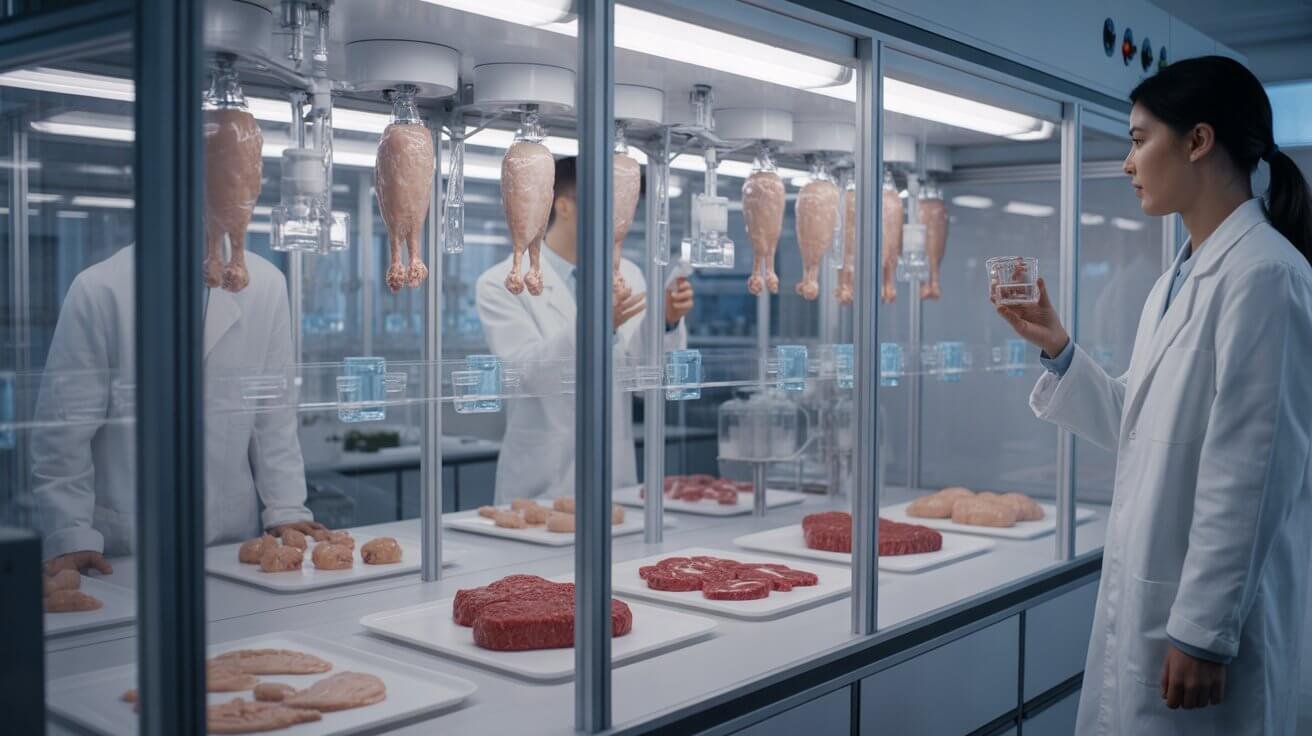
Here’s how it works: scientists take a small sample of cells from an animal through a harmless biopsy. These cells are then placed in bioreactors—essentially large tanks that act like artificial wombs. The cells are fed a nutrient-rich medium containing amino acids, sugars, vitamins, and minerals. Under carefully controlled conditions, these cells multiply and grow into muscle tissue.
The result? Real meat that’s genetically identical to what you’d get from a slaughtered animal, but produced without raising, feeding, or killing any livestock.
The Science Behind Growing Meat in Labs
Synthetic meat relies on decades of research in tissue engineering and regenerative medicine. The process starts with selecting the right type of cells. Scientists typically use stem cells or satellite cells—these are the repair cells that naturally help animals build muscle. What makes these cells special is their ability to multiply rapidly and differentiate into different types of tissue.
Once harvested, the cells are placed in bioreactors where they’re fed a growth medium. Traditional methods used fetal bovine serum (essentially blood from unborn calves), but newer techniques have developed animal-free alternatives. Usually, cultured chicken grows in a nutrient-rich serum harvested from live chicken blood: this serum is a strikingly large driver of cost in cultured meat—accounting for 40-60% of the production price. So when the researchers found a way to make an entirely animal-free medium—consisting instead of sugars called cyclodextrins and other ingredients, they dramatically reduced costs.
Recent breakthroughs have been impressive. Researchers at Hebrew University grew chicken meat cells at four times the density they are grown in regular bioreactor systems, making production more efficient and cost-effective.
Environmental Benefits That Actually Matter
Traditional livestock farming is an environmental nightmare. According to the Environmental Protection Agency, it’s responsible for massive greenhouse gas emissions, deforestation, and water pollution. But synthetic meat offers a dramatically different footprint.
The numbers are staggering. According to a study by the Good Food Institute, cultivated meat produced using renewable energy could reduce greenhouse gas emissions by up to 92% and land use by up to 90% compared to conventional beef.
Water usage drops just as dramatically. According to Environmental Science & Technology, the results showed that production of 1000 kg cultured meat requires 26-33 GJ energy, 367-521 m(3) water, 190-230 m(2) land, and emits 1900-2240 kg CO(2)-eq GHG emissions. In comparison to conventionally produced European meat, cultured meat involves approximately 7-45% lower energy use (only poultry has lower energy use), 78-96% lower GHG emissions, 99% lower land use, and 82-96% lower water use depending on the product compared.
What’s particularly exciting is the efficiency of synthetic meat compared to traditional farming. The LCA shows that cultivated meat is 3.5 times more efficient than conventional chicken (the most efficient form of conventional meat production) at converting feed into meat.
However, there’s a catch. The environmental benefits largely depend on using renewable energy. If renewables are used, the carbon footprint of cultivated meat production drops by 80 percent. Without renewable energy, the high electricity requirements of bioreactors could actually increase the carbon footprint compared to some conventional meats.
Current State of the Synthetic Meat Industry in 2025
The synthetic meat industry has grown rapidly. As reported by the Good Food Institute, as of 2024, the industry has grown to over 175 companies on six continents, backed by over $3.1 billion in investments.
Market projections are impressive. The global synthetic meat market size reached USD 524 million in 2025 and is projected to expand at a CAGR of 12.6% from 2025 to 2033. Even more optimistic forecasts suggest the global cultured meat market, valued at USD 0.27 billion in 2025, is projected to reach USD 23 billion in 2035 and USD 229 billion by 2050, representing a CAGR of 31% during the forecast period.
So far, only a handful of countries have approved synthetic meat for sale. Singapore led the way in 2020, followed by the United States in 2023, and Israel in 2024. In July 2023, Upside put food on the plates of the Michelin-starred Bar Crenn in San Francisco. Competition winners were the first in the U.S. to try cultured chicken fillets, for just $1!
But it’s not all smooth sailing. Issues are still present for the industry though, with U.S. states keen to ban lab-grown meat soon. Florida’s Republican lawmaker Tyler Sirois recently drafted legislation to lab-grown meat in Florida. Arizona has also drafted a similar bill, in fears it could impact the state’s land use and economy.
Production capacity remains a major bottleneck. In 2023, Eat Just’s production capacity yields just 4.4 lb (3kg) per week in Singapore. A Singapore butchery sells nearly 1,100 lbs (5,000 kg) of slaughtered chicken every week!
Real-World Examples and Success Stories
Several companies are making impressive strides in synthetic meat:
UPSIDE Foods has been a pioneer in the U.S. market. According to USDA approval documents, they’ve successfully created chicken fillets that are virtually indistinguishable from traditional chicken in taste and texture.
Good Meat (part of Eat Just) became the first company to sell synthetic meat commercially in Singapore. They’ve expanded beyond nuggets to create whole-muscle products.
Believer Meats (formerly Future Meat) has achieved remarkable cost reductions. In fact, in 2021, the company announced it could make almost a pound of cultivated chicken for $7.70, with a 110-gram chicken breast costing $1.70 to make.
Meatly in the UK took a different approach, focusing first on pet food. This strategy helps familiarize consumers with the concept while avoiding the more complex regulatory hurdles of human food approval.
The Economics of Growing Meat
Cost has been the biggest hurdle for synthetic meat. The first lab-grown burger in 2013 cost $325,000 to make. However, costs have dropped dramatically.
In a March 2015 interview, Post said that the marginal cost of his team’s original €250,000 burger was now €8.00. He estimated that technological advancements would allow the product to be cost-competitive to traditionally sourced beef in approximately ten years.
Recent studies suggest we’re getting closer to cost parity. According to research published in ScienceDirect, assuming that technology will be developed to reduce the cost of the medium including growth hormone substitutes and buying ingredients in bulk, 1 kg of cell-cultured meat is estimated to cost $63/kg to produce in a large-scale facility.
The current average cost of a homemade cheeseburger is around $2.56 in the U.S., while synthetic meat is predicted to cost around $11 by 2030. That’s still more expensive, but it’s getting closer to competitive pricing.
Challenges and Future Implications
Despite its promise, synthetic meat faces significant challenges:
Scalability remains the biggest issue. Current production facilities can’t match the volume needed for mass market adoption. Most companies are still operating at pilot scale rather than commercial scale.
Consumer acceptance varies widely. When surveyed, of the 149 people who responded, 99 said no. Not the most encouraging response – but that does mean 44 percent of respondents were open to trying it.
Regulatory hurdles persist. Europe remains particularly cautious about approving synthetic meat products for human consumption.
However, the technology continues to improve rapidly. New innovations include plant-based scaffolding and 3D bioprinting techniques that make synthetic meat virtually indistinguishable from traditional meat in texture and structure.
The Path Forward
The future of synthetic meat depends on several key factors. First, continued technological advancement to reduce production costs and improve scalability. Second, regulatory approval in major markets like Europe and broader acceptance in Asia. Third, consumer education and acceptance.
Environmental pressure is driving much of the interest in synthetic meat alternatives. According to the UNEP, the growing awareness of the environmental impact of animal agriculture, the increasing prevalence of veganism and vegetarianism, and technological advancements are all contributing to market growth.
Countries aiming to reduce their carbon footprint can achieve greater emissions reductions by replacing conventional meat with synthetic meat than they could through other dietary changes alone, as outlined in the Paris Agreement climate targets.
Conclusion
Synthetic meat isn’t just another food trend—it’s a potential solution to some of our most pressing global challenges. While significant hurdles remain around cost, scale, and consumer acceptance, the technology has advanced remarkably in just over a decade.
The industry has proven that lab-grown meat can taste like traditional meat, match its nutritional profile, and dramatically reduce environmental impact. Now it’s a race to make it affordable and widely available.
Whether you’re motivated by environmental concerns, animal welfare, or simply curiosity about food innovation, synthetic meat deserves attention. It may not replace traditional meat entirely, but it could become an important part of our future food system.
The question isn’t whether synthetic meat will succeed, but how quickly it can scale up to make a meaningful impact. Based on current progress and investment levels, we might see synthetic meat on grocery store shelves within the next few years. That burger from a lab isn’t just possible—it’s inevitable.