
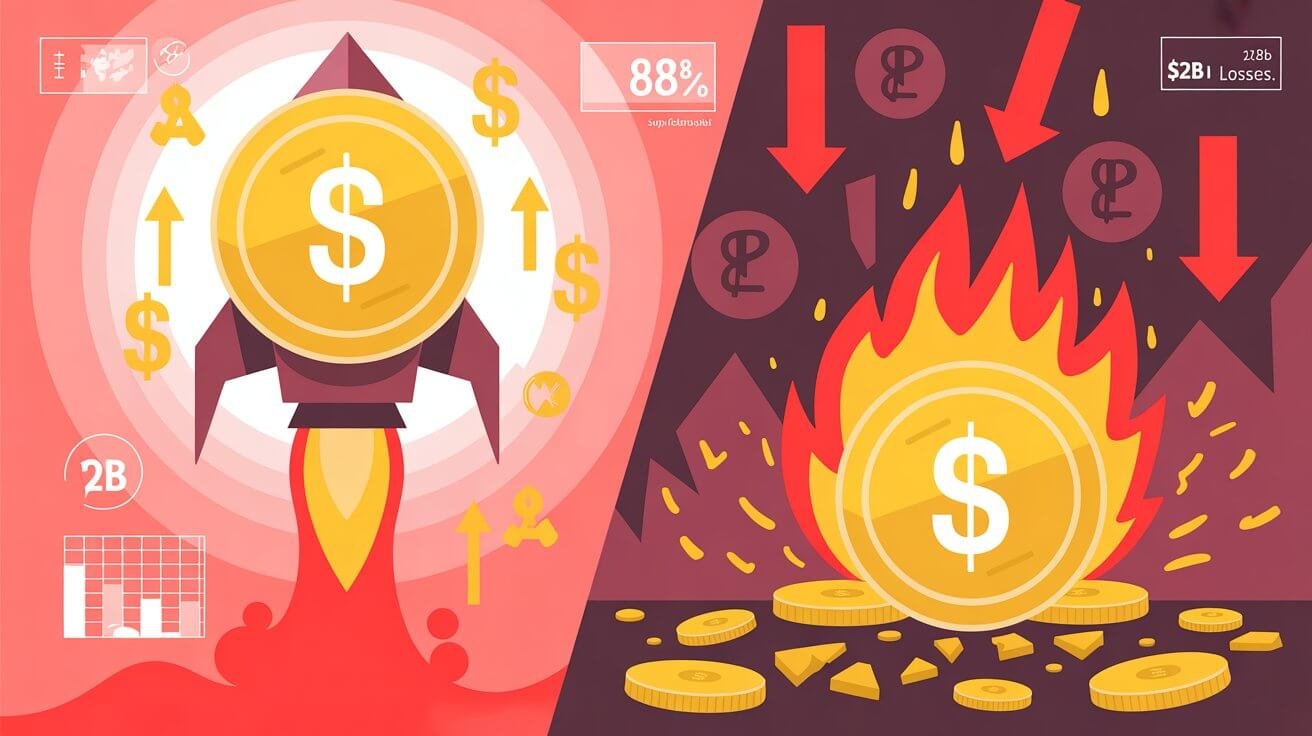

The Trump meme coin investment risks became a harsh reality when what started as a presidential crypto venture turned into one of the most spectacular financial disasters in recent memory. Remember when your uncle bought Bitcoin at its peak? Well, multiply that regret by a thousand, and you’ll understand how tens of thousands of investors feel about the Trump meme coin collapse. These Trump meme coin investment risks weren’t just theoretical market concerns—they manifested as billions in losses for everyday Americans who trusted their president’s business venture.
The Trump meme coin investment risks weren’t just theoretical—they became painfully real for over 764,000 wallets that lost money. Moreover, these Trump meme coin investment risks extend far beyond simple market volatility, touching on ethical concerns, regulatory uncertainty, and the dangerous intersection of politics and speculative finance.
Understanding Trump Meme Coin Investment Risks: From Inauguration Hype to $15 Billion in Days
Three days before his second inauguration, Donald Trump shocked the crypto world by launching the $TRUMP meme coin. Within 48 hours, the token’s value skyrocketed to $75 per coin, giving it a staggering market cap of $15 billion, according to CoinGecko data.
But here’s where things get interesting—and concerning. The Trump Organization and affiliated entities controlled 80% of the coin’s supply. This means while everyday investors were buying in at peak prices, the creators held the vast majority of tokens that could theoretically flood the market at any time.
The launch timing wasn’t coincidental either. The crypto community was already buzzing from the inauguration’s “Crypto Ball,” where industry leaders gathered to celebrate Trump’s pro-crypto stance. However, many crypto veterans immediately called the move “grifty” and a “mockery” of the industry they’d worked to legitimize, as TIME magazine reported.
The Meme Coin Investment Risks Realized: 88% Value Destruction in Weeks
What goes up fast in the crypto world often comes down even faster. By February 2025, the $TRUMP coin had lost 75% of its value. Today, it trades around $9—representing an 88% decline from its January peak, according to Fortune’s reporting.
The collapse wasn’t gradual. Several factors triggered massive sell-offs:
Tariff Announcements Triggered Market Panic
When Trump announced sweeping tariffs on Canada, Mexico, and China, crypto markets tumbled. Interestingly, his own meme coin led the decline, dropping 18% in a single day as investors feared economic uncertainty would hurt speculative assets, as CNBC documented.
Regulatory Backlash and Ethics Investigations
Democratic lawmakers didn’t stay quiet. Senator Elizabeth Warren and Representative Jake Auchincloss launched formal investigations, writing to the SEC, Treasury Department, and Office of Government Ethics about potential conflicts of interest. They highlighted how foreign entities could essentially buy influence by purchasing the president’s cryptocurrency.
The timing of regulatory statements also raised eyebrows. Just weeks after the coin’s launch, the SEC conveniently announced that meme coins wouldn’t be treated as securities—effectively removing oversight from Trump’s venture, as CNBC’s analysis revealed.
The Human Cost: Real Stories, Real Losses
Behind the numbers are real people who trusted their president’s business acumen. Rebecca Davis, a conservative radio host from Little Rock, put $32 into the coin. Today, her investment is worth about $11. “There was definitely a lot of influential people that had posted online about it that got me hyped up,” she told The Washington Post. “Then when it tanked, I was like, ‘Whoa, what the hell?'”
The data reveals the stark inequality of outcomes, according to Chainalysis research:
- 58 wallets made over $10 million each (totaling $1.1 billion in profits)
- 764,000 wallets lost money, mostly small-time investors
- The typical debit card buyer spent $100 and lost $62
Meanwhile, the Trump family’s entities collected approximately $100 million in trading fees alone—money they earned regardless of whether investors made or lost money.
Trump Crypto Investment Risks: Why This Collapse Was Predictable (And Avoidable)
Several red flags should have warned investors about the extreme risks:
Presidential Meme Coin Investment Risks: Centralized Control in a Decentralized World
Cryptocurrency’s founding principle is decentralization—no single entity should control the market. Yet the Trump team controlled 80% of the token supply, giving them unprecedented power to manipulate prices. This concentration violated every principle that makes crypto valuable.
No Underlying Value or Utility
Unlike Bitcoin, which serves as digital gold, or Ethereum, which powers smart contracts, the $TRUMP coin had no purpose beyond speculation. It was essentially a digital collectible backed by presidential celebrity rather than technological innovation.
Celebrity Crypto Investment Risks
History shows that celebrity-backed crypto ventures often fail spectacularly. From Kim Kardashian’s EthereumMax settlement to various influencer coin collapses, the pattern is clear: when celebrities promote crypto for personal gain rather than genuine belief in the technology, investors usually lose. The Federal Trade Commission has increasingly warned about celebrity crypto endorsements for this reason.
The Broader Implications: Democracy Meets Decentralized Finance
This isn’t just a crypto story—it’s a cautionary tale about power, influence, and the corruption risks when political leaders launch financial products.
Foreign Influence Concerns
Anyone, anywhere in the world, could buy $TRUMP coins anonymously. This created what ethics experts called a “virtual, quasi-anonymous way to curry favor with the president.” Imagine Vladimir Putin or Xi Jinping secretly purchasing millions of dollars worth of the coin to boost its value and enrich the sitting U.S. president, as Harvard’s Allen Lab for Democracy Renovation warned.
The Dinner Debacle
Perhaps most troubling was the “investment dinner” promotion. The Trump team promised the top 220 coin holders a private dinner with the president and White House tour. The coin’s value jumped 50% after this announcement, essentially creating a pay-to-play system where cryptocurrency purchases bought access to the president.
Legal experts noted this potentially violated federal ethics rules and the Emoluments Clause of the Constitution. Representatives Sean Casten and Adam Smith called for a Department of Justice investigation, describing the event as selling access to the presidency.
Investment Risk Lessons for Future Crypto Investors
The Trump meme coin collapse offers valuable lessons that extend beyond this specific incident:
Due Diligence Is Non-Negotiable
Before investing in any cryptocurrency, especially meme coins, ask critical questions:
- Who controls the token supply?
- What real-world problem does this solve?
- Are the creators motivated by technology advancement or personal profit?
- What’s the regulatory landscape?
Beware of FOMO Marketing
The Trump coin’s success relied heavily on social media hype and celebrity endorsement rather than technological merit. When promotional tactics focus on personality rather than utility, that’s a major red flag.
Understand the Regulatory Environment
The timing of various regulatory announcements around the Trump coin launch suggests the rules can change quickly based on political considerations. Investors need to understand that regulatory clarity—or lack thereof—significantly impacts crypto values.
The Future: What Comes Next?
As Trump continues expanding his crypto empire with stablecoins and other ventures, the lessons from the meme coin collapse remain relevant. The administration has signed executive orders allowing crypto investments in 401(k) retirement plans, potentially exposing millions more Americans to these risks, according to NBC News reporting.
Meanwhile, Democratic lawmakers have introduced the “End Crypto Corruption Act,” which would ban the President, Vice President, and other senior officials from benefiting from crypto assets. Whether this legislation passes remains uncertain.
The crypto industry itself is soul-searching. Many legitimate blockchain developers worry that ventures like the Trump meme coin damage the industry’s credibility and set back efforts to create useful, world-changing technology, as noted by cryptocurrency researchers.
Bottom Line: Power and Profit Don’t Mix
The Trump meme coin collapse serves as a stark reminder that mixing political power with personal financial ventures creates dangerous conflicts of interest. While some early investors made money, the vast majority lost significant sums while enriching the very people they trusted to look out for their interests.
For crypto investors, the lesson is clear: celebrity endorsements and political connections don’t create sustainable value. Real cryptocurrency innovations solve real problems and build lasting ecosystems. Everything else is just speculation—and speculation involving the most powerful person in the world carries risks that go far beyond typical market volatility.
The collapse wasn’t just about bad investment returns. It was about trust, ethics, and the fundamental question of whether elected officials should profit from ventures that their regulatory decisions directly impact. As crypto continues evolving, these questions will only become more important.
The Trump meme coin investment risks extended beyond financial losses to threaten the integrity of both cryptocurrency markets and democratic institutions. That’s a cost too high for any investment return.