
I’ve been following neuroscience research for years, but what’s happening right now with dream brain interface technology is unlike anything I’ve seen before. Scientists have successfully enabled two people to communicate during REM sleep – one person speaks a word in their dream, and another receives it through their own dream state. Moreover, this breakthrough in dream brain interface technology represents just the beginning of what could fundamentally change how we experience sleep, consciousness, and human connection.
The implications are staggering. Furthermore, researchers are developing systems that can record, decode, and even share dream content between individuals, transforming the third of our lives spent sleeping into potentially productive, connected experiences.
The Science Behind Shared Dreams: How It Actually Works
Dream brain interface technology relies on sophisticated monitoring of brain activity during sleep, particularly during REM (rapid eye movement) phases when most vivid dreaming occurs. According to recent neuroscience research, dream experience is promoted by significant brain activation, characterized by reduced low frequencies and increased rapid frequencies.
Breaking Down the Communication Process
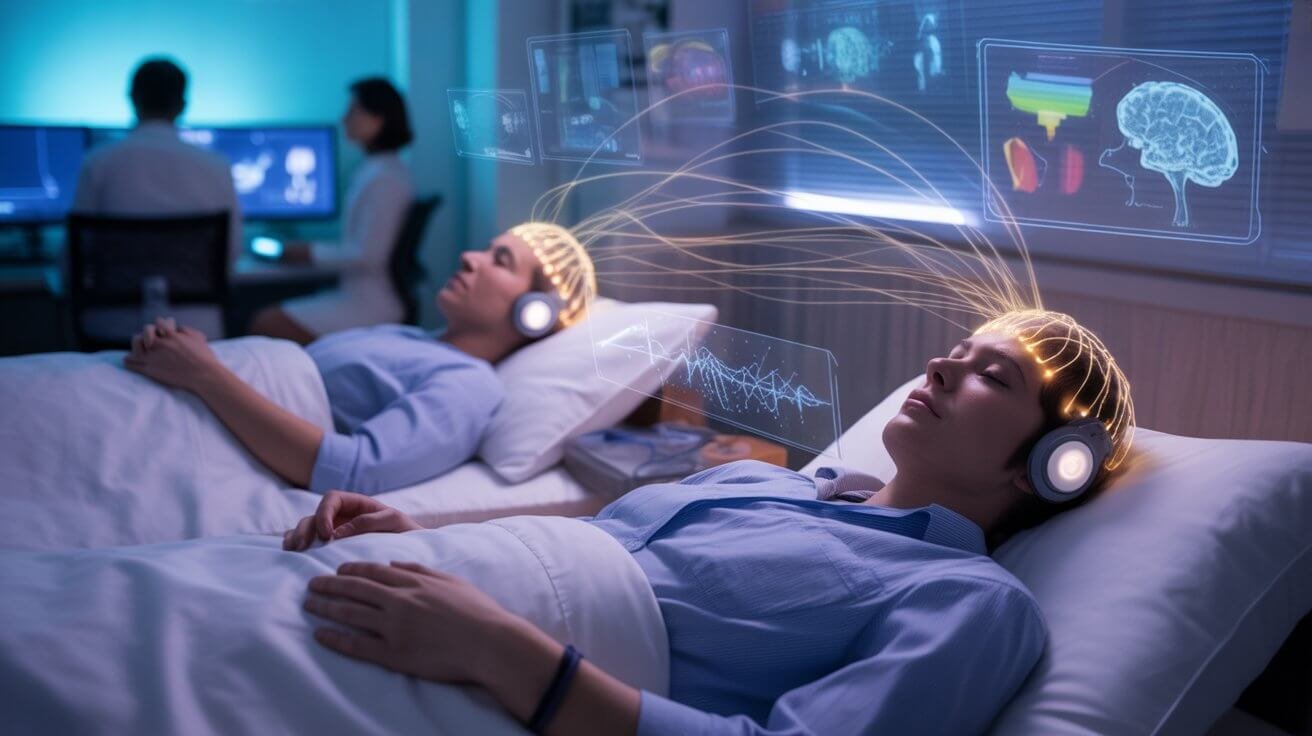
Recent research documented in 2024 shows that scientists achieved inter-dream communication using a relatively simple setup. One participant spoke a word during their dream, and facial electromyography sensors captured their speech, sending it to a central server. Subsequently, the second participant, also in REM sleep, received this word through an earbud.
Both participants confirmed upon awakening that they had successfully “spoken” and “heard” the word during their respective dreams. Additionally, this milestone opens doors to applications in mental health treatment, skill training, and immersive entertainment.
The Technology Stack Making Dreams Shareable
Dream brain interface technology combines several cutting-edge components:
- EEG (Electroencephalogram) monitoring to detect sleep stages and brain activity patterns
- Facial electromyography sensors to capture attempted speech during dreams
- AI-powered neural networks to decode and interpret brain signals
- Targeted audio stimulation to deliver information into dream states
- Real-time processing systems to enable communication across sleeping minds
According to IEEE research, scientists have identified neural mechanisms equivalent to imagination and daydreaming, where mental creation of images overrides visual input. Therefore, the foundation exists for much more sophisticated dream sharing experiences. Additionally, research published in PMC demonstrates that controlling brain-computer interface devices is possible from within lucid dreams.
Current Capabilities: What We Can Actually Do Right Now
Dream brain interface technology has moved beyond theoretical research into practical applications that are available today.
Lucid Dream Induction and Control
Companies like Prophetic are developing wearable devices specifically designed to stabilize lucid dreams. Their “Halo” device, created in partnership with Card79 (the same company that built hardware for Neuralink), uses focused ultrasound to stimulate the prefrontal cortex during sleep.
The goal is to create a “closed loop” where AI learns what sequences of brain states and neuro-stimulation maximize prefrontal cortex activation – essentially enhancing the user’s ability to remain conscious and in control while dreaming. Furthermore, scientific research on lucid dreaming shows that recent advances in wearable neurotechnology increasingly facilitate the decoding of this intriguing phenomenon.
Dream Recording and Reconstruction
Teams in Kyoto, Japan, have developed systems capable of interpreting and reconstructing dream imagery using functional magnetic resonance imaging (fMRI) and artificial intelligence. The system analyzes sleeping participants’ brain activity and matches neural signals with an image database, effectively creating visual representations of dream content.
This dream brain interface technology breakthrough means we’re approaching the ability to literally see what someone else dreamed about. Moreover, ongoing research into dream engineering explores the application of sensory stimulation technologies to manipulate dream content through various virtual reality approaches.
Real-Time Brain Activity Monitoring
Research published in Nature Electronics demonstrates that brain-computer interfaces can translate neural signals into sentences at speeds close to normal conversation – around 150 words per minute. While this research focused on waking states, the same principles apply to sleep-based communication systems. Additionally, studies from the Dana Foundation highlight the growing collaboration between neuroscience and society in developing these technologies.
Practical Applications: Beyond Science Fiction
Dream brain interface technology offers tangible benefits across multiple domains, moving far beyond entertainment into therapeutic and educational applications.
Mental Health and Trauma Treatment
Dreams naturally process emotions and memories. Consequently, controlled dream environments could provide safe spaces for trauma therapy. Research suggests that scientists can help patients with trauma through guided dream experiences, potentially accelerating healing processes that normally take months or years. Furthermore, studies on brain-computer interface applications demonstrate significant potential for treating neurological disorders and improving quality of life.
Skill Training and Education
Imagine practicing a presentation, rehearsing a musical performance, or training muscle memory while you sleep. Moreover, dream brain interface technology could enable “productive sleeping” where the eight hours typically considered downtime become opportunities for learning and skill development. Current brain-computer interface market research shows significant growth in educational and research applications.
Communication for Individuals with Disabilities
As noted by researchers, it’s now possible to control brain-computer interface devices from within lucid dreams. This capability could provide new communication channels for individuals with severe motor disabilities or locked-in syndrome, offering independence and connection through dream-state interactions.
Enhanced Creativity and Problem-Solving
Many breakthrough discoveries have occurred during sleep or dreams. Subsequently, dream brain interface technology could create environments specifically designed to enhance creative thinking, allowing teams to collaborate on complex problems even while unconscious. Research into citizen neuroscience shows how wearable technology enables brain research in natural habitats, including sleep environments.
Future Implications: The Coming Dream Revolution
The trajectory of dream brain interface technology suggests dramatic changes ahead for human consciousness and social interaction.
Collective Dream Experiences
Research into “Inter-Dream” systems demonstrates integration with the brain’s autonomic physiological processes to drive users toward healthy sleep states. Furthermore, “PsiNet” systems integrate interpersonal brain activity to amplify human connection.
These developments point toward shared dream spaces where multiple people could collaborate, create, or simply socialize within collective unconscious experiences.
AI-Enhanced Dream Content
As artificial intelligence becomes more sophisticated, dream brain interface technology could incorporate AI-generated content directly into dreams. Therefore, you might experience historically accurate ancient Rome, explore alien worlds designed by AI, or receive personalized therapeutic experiences tailored to your specific psychological needs. Future predictions for EEG technology suggest that reading dream content could be achievable within 50 years.
Privacy and Security Considerations
However, the ability to access, record, and potentially manipulate dreams raises serious ethical questions. Current neuro-rights legislation includes provisions for:
- Right to mental privacy
- Right to own identity
- Right to own decision-making
- Equal access to mental augmentation
- Protection against bias in artificial intelligence
Actionable Steps: Preparing for the Dream-Sharing Future
While advanced dream brain interface technology remains in development, you can start exploring related technologies and concepts today.
Explore Lucid Dreaming Techniques
Practice reality checks throughout your day – regularly question whether you’re dreaming. This habit carries over into sleep, increasing lucid dream frequency.
Keep a dream journal to improve dream recall and pattern recognition. Moreover, better dream awareness creates the foundation for eventual interface control.
Try existing consumer devices like the iBand or other EEG-based sleep monitors that can detect REM phases and provide gentle stimulation to encourage lucidity.
Stay Informed About Emerging Technologies
Follow neurotechnology companies developing dream-related products. Companies like Prophetic, Neuralink, and various university research labs regularly publish updates on their progress. Industry analysis shows that brain-computer interfaces are becoming smaller, sleeker, and more wearable.
Participate in citizen science projects using platforms like Dreamento, which enables the largest multi-center lucid dream induction studies with physiological data. European research initiatives are exploring both promises and risks of brain-computer interfaces.
Consider the Implications
Think about privacy preferences for future dream-sharing technologies. What aspects of your dream life would you want to keep private versus share with others?
Explore creative applications by considering how dream sharing might enhance your professional or personal relationships.
Prepare for Regulatory Changes
As dream brain interface technology advances, regulations will evolve to protect users while enabling innovation. Therefore, staying informed about neuro-rights legislation helps you understand your future rights and protections.
The Bottom Line: Dreams as the Next Digital Frontier
Dream brain interface technology represents more than just scientific curiosity – it’s the next frontier in human-computer interaction. We’re approaching a future where the boundary between sleeping and waking consciousness becomes permeable, where dreams become collaborative spaces, and where sleep transforms from passive rest into active engagement.
The technology isn’t science fiction anymore. Real systems are enabling dream communication, recording dream content, and enhancing lucid dream experiences today. While challenges around privacy, safety, and ethics remain, the potential benefits – from enhanced creativity to new therapeutic approaches – suggest that dream sharing will become an integral part of human experience.
Whether you’re excited or cautious about these developments, dream brain interface technology will likely impact your life within the next decade. The question isn’t whether dream sharing will happen, but how we’ll choose to use these powerful new capabilities to enhance human connection and consciousness.
As we stand on the threshold of this new era, one thing is certain: the future of sleep will be anything but passive.