
I just watched robots play soccer, and honestly? It was both hilarious and terrifying. China recently hosted the World Humanoid Robot Games, marking the first time in history that humanoid robots competed in Olympic-style sports. Meanwhile, the country installed a staggering 290,000 industrial robots in 2024, cementing its position as the global robotics superpower.
This isn’t just about entertainment. China’s World Humanoid Robot Games represent a calculated move in the global AI race, showcasing capabilities that could reshape entire industries. Moreover, with these developments happening alongside massive industrial robot deployments, we’re witnessing China’s strategic push toward complete automation dominance.
China’s Humanoid Robot Revolution Takes Center Stage
From August 14-17, 2025, Beijing’s National Speed Skating Oval transformed into the world’s first arena dedicated to humanoid robot athletics. Over 500 bipedal robots from 280 teams across 16 countries competed in everything from track and field to kickboxing.
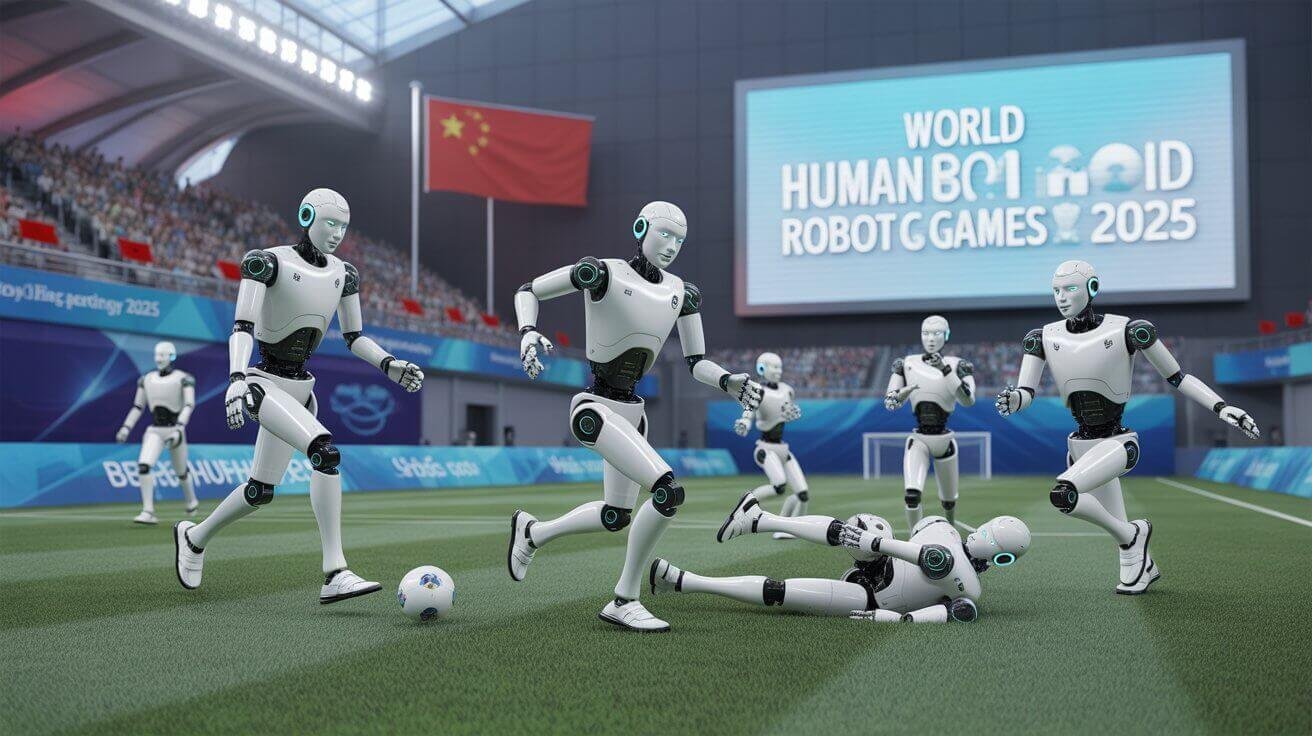
But don’t expect to see Usain Bolt-level performance just yet. Spectators witnessed plenty of awkward stumbles, face-plants, and robots walking into each other during soccer matches. However, beneath the entertainment value lies serious technological advancement.
The Real Competition Behind the Games
According to Xinhua’s coverage, industry analysts view 2025 as a landmark year for advances in robots’ movement capabilities. The World Humanoid Robot Games featured diverse competitions like football, gymnastics, and dance, fully showcasing robots’ progress in motion execution, situational adaptability, and human interaction.
“Humanoid robots today resemble the internet in the 1980s — poorly understood yet transformative,” noted one researcher. “But I believe that in the near future, robots could become as ubiquitous as smartphones.”
Beyond Sports: Practical Applications Testing Ground
While robot soccer made headlines, the most intriguing aspects of the World Humanoid Robot Games occurred in scenario-based challenges. Robots demonstrated practical skills including:
- Drug sorting in simulated hospital environments
- Hotel concierge services and housekeeping tasks
- Factory material handling and logistics
- Customer service interactions
These applications reveal China’s strategic focus. Rather than building robots just for entertainment, teams tested capabilities directly transferable to real-world employment scenarios.
Industrial Robot Dominance Accelerates
China’s robot push extends far beyond humanoid competitions. According to the International Federation of Robotics, China installed 276,288 industrial robots in 2023, representing 51% of global installations. Furthermore, the operational stock reached nearly 1.8 million units, making China the first and only country with such massive robot deployment.
What’s remarkable is the acceleration. Data shows that over the past decade, the number of robots per 10,000 workers in China’s manufacturing sector surged from 49 to 470.
Strategic Implications: The Robot Race for Global Dominance
China’s hosting of robot competitions isn’t coincidental. These events serve multiple strategic purposes beyond technological showcasing.
Economic Transformation Through Automation
The Chinese government has targeted humanoid robots as a key future industry for the economy. Beijing plans to build a world-class humanoid robot industry by 2027, with projections suggesting China’s embodied intelligence market could surpass 1 trillion yuan (about $139.52 billion) by 2031.
This transformation addresses pressing demographic challenges. With an aging population and rising labor costs, automation becomes essential for maintaining manufacturing competitiveness. Additionally, the World Humanoid Robot Games demonstrate how China leverages innovation-driven development to secure a prominent position in global industrial competition.
Geopolitical Technology Competition
The timing of China’s robot initiatives carries significance in the broader US-China technology competition. As NBC News reported, both countries consider AI a national security issue, with the US seeking to restrict China’s access to advanced semiconductor chips needed for AI model training.
However, China’s approach differs strategically. While the US backs market-driven AI aligned with liberal norms, China promises to help developing countries with AI as a means to promote state control, according to the Atlantic Council.
What This Means for the Future of Work
The implications extend beyond manufacturing floors. Watching robots attempt human-like tasks reveals both current limitations and future potential.
Capabilities vs. Reality Check
During the World Humanoid Robot Games, spectators observed mixed results. Unitree’s H1 humanoid robot won gold in the 400m and 1,500m races, demonstrating impressive athletic capability. Conversely, soccer matches featured robots crashing into each other and falling in tangled heaps.
These contrasts highlight current robotics reality: excellent performance in controlled, specific tasks, but ongoing challenges with dynamic, unpredictable environments requiring human-like adaptability.
Job Market Transformation Timeline
Industry experts predict companion robots could enter homes within a few years, while heavy-duty industrial models may take longer to commercialize. StarBot’s representative noted their goal: “we hope to be in people’s homes and restaurants, hotels, and I think in the future, many people will have robots involved in their life.”
This gradual integration suggests workplace transformation will occur in waves rather than sudden displacement. Service industries, manufacturing, and logistics appear positioned for earliest adoption.
Actionable Insights for Businesses and Individuals
Understanding China’s robot strategy provides valuable guidance for preparation and opportunity identification.
For Business Leaders
Evaluate automation readiness: China’s success stems from comprehensive industrial planning. Research shows Chinese manufacturers now capture 47% of domestic robot installations, up from a decade-long average of 28%.
Consider partnership opportunities: The World Humanoid Robot Games demonstrated international collaboration benefits. Teams using Chinese-manufactured robots (like Unitree and Booster) alongside international algorithms achieved competitive results.
Plan workforce transition: Rather than fearing displacement, smart companies are preparing workers for human-robot collaboration scenarios tested during the games.
For Individual Career Development
Focus on uniquely human skills: Robot limitations observed during competitions – creativity, emotional intelligence, complex problem-solving in unpredictable situations – remain human advantages.
Understand automation trends: Industries showing highest robot adoption (automotive, electronics, logistics) will likely see continued transformation.
Develop technical literacy: As robots become ubiquitous, understanding their capabilities and limitations becomes valuable across professions.
The Road Ahead: Competition, Cooperation, and Coexistence
China’s World Humanoid Robot Games represent more than technological demonstration. They signal a strategic vision where robotics integration drives economic transformation and global competitiveness.
However, this future isn’t predetermined. As noted by industry analysts, while China leads in manufacturing scale and cost efficiency, significant gaps remain in software, operating systems, and advanced components.
The ultimate question isn’t whether robots will transform work and society – that’s already happening. Instead, it’s how different countries and companies will navigate this transformation to create beneficial outcomes for both humans and machines.
China’s approach emphasizes state-led industrial planning combined with international collaboration opportunities. The World Humanoid Robot Games exemplify this strategy: showcasing domestic capabilities while inviting global participation and knowledge exchange.
Whether you’re watching robots stumble through soccer matches or marveling at their precision in factory tasks, one thing is clear: the future of human-robot interaction is being written today, and China is determined to hold the pen.