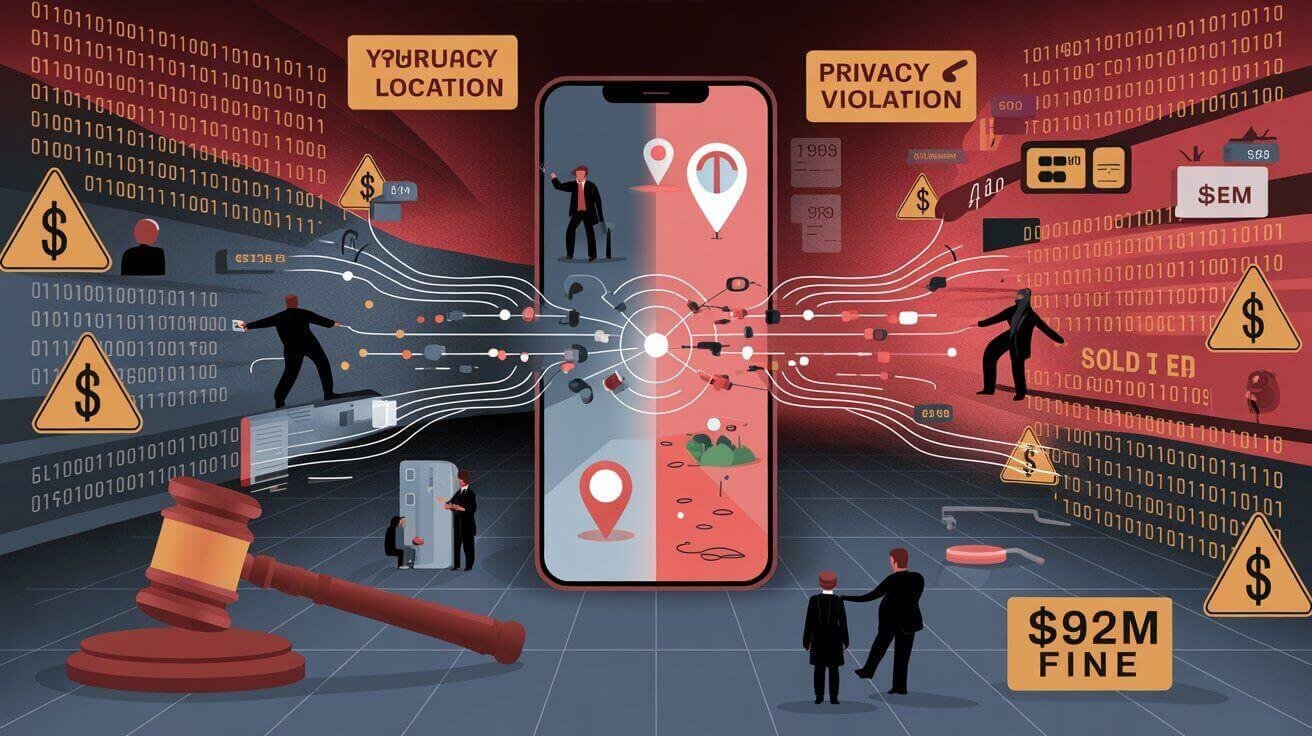

T-Mobile’s shocking $92 million fine just became final, and the details will make your skin crawl. For years, the telecom giant was secretly selling your most private information—your exact location—to anyone willing to pay. The T-Mobile location data privacy scandal reveals just how little these companies value your personal information, despite their polished marketing promises about security. Furthermore, what’s even more disturbing is that T-Mobile knew about the abuse but continued selling location data without taking meaningful action to protect customers. This T-Mobile location data privacy crisis isn’t just about one company’s greed—it’s a wake-up call about how your most sensitive information gets treated like a commodity.
The Shocking Truth About T-Mobile Location Data Privacy Violations
The recent court ruling against T-Mobile exposes a systematic operation that treated customer privacy as an afterthought. Moreover, the company sold location access to data aggregators LocationSmart and Zumigo, who then resold this information to various third-party service providers without proper consent verification.
How the Location Tracking Actually Worked
Your phone constantly pings cell towers to maintain connection, creating a digital breadcrumb trail of your exact movements. Additionally, T-Mobile and other carriers collected this data and packaged it for sale to companies you’ve never heard of.
The process was disturbingly simple:
- T-Mobile collected real-time location data from customer phones
- Data aggregators like LocationSmart purchased access to this information
- Third-party companies could then track virtually anyone’s location in real-time
- No meaningful consent verification protected customers from abuse
Consequently, a Missouri sheriff used this system to track a judge and law enforcement officers—highlighting how easily the system could be weaponized for stalking, harassment, or worse.
The Scale of the Mobile Data Privacy Breach
The violation wasn’t limited to a few isolated incidents. Instead, the FCC investigation revealed that T-Mobile sold access to customer location information for years, generating millions in revenue while exposing customers to serious privacy risks.
Circuit Judge Florence Pan emphasized the gravity of the situation: “Congress imposed on carriers a general duty to protect all customer location information, regardless of whether the customer is on a call.” The court’s decision establishes that location data qualifies as “customer proprietary network information” under federal law.
What T-Mobile Data Privacy Violations Mean for Your Security
Understanding how your personal information was compromised helps explain why this case matters beyond just one company’s bad behavior. Therefore, examining the real-world impact reveals why stronger privacy protections are essential.
The Real-World Consequences of Data Selling
Location data represents some of the most intimate information about your life. It reveals where you live, work, worship, seek medical care, and spend your personal time. When companies sell this information without consent, they’re essentially selling your daily routine to unknown buyers.
Consider these troubling possibilities:
- Stalkers could track victims in real-time
- Insurance companies might adjust rates based on your locations
- Employers could monitor where you go during lunch breaks
- Governments could track protest movements or political gatherings
The LocationSmart case became particularly alarming when security researchers discovered the company had an unsecured demo on its website. Anyone could use this tool to find the near-exact location of virtually any mobile phone in North America—no authorization required.
Why Traditional Privacy Policies Failed
T-Mobile’s privacy policy contained language about data sharing, but customers had no meaningful way to understand or control how their location information was being sold. Subsequently, the company tried to shift responsibility to downstream data buyers, claiming they were supposed to obtain proper consent.
This blame-shifting strategy failed spectacularly in court. The judges ruled that T-Mobile couldn’t escape responsibility by claiming other companies should have protected customer privacy.
How Current Privacy Laws Protect Your T-Mobile Location Data
Recent legal developments provide stronger tools for protecting your personal information, but understanding your rights requires navigating complex regulations that vary by state and circumstance.
California Consumer Privacy Act (CCPA) Protections
California residents gained significant new rights under the CCPA, which treats location data as “sensitive personal information.” Therefore, companies must provide clear opt-out mechanisms and limit how they use this data.
Under CCPA, you have the right to:
- Know what personal information companies collect about you
- Request deletion of your personal information
- Opt out of the sale or sharing of your information
- Correct inaccurate personal information
- Limit the use of sensitive personal information
Additionally, businesses cannot discriminate against you for exercising these rights, meaning they can’t charge you more or provide worse service if you opt out of data selling.
Federal Communications Commission (FCC) Enforcement
The FCC’s $92 million fine against T-Mobile represents the largest privacy-related penalty in the agency’s history. Moreover, this enforcement action sends a clear message that telecommunications companies must treat customer location data with appropriate care.
The FCC ruling established several important principles:
- Location data qualifies as protected customer information under federal law
- Carriers cannot shift privacy responsibilities to third parties
- Real-time location tracking requires explicit customer consent
- Companies must implement reasonable safeguards against unauthorized access
Practical Steps to Protect Your T-Mobile Location Data Privacy
While you can’t completely prevent data collection, you can take concrete actions to limit how companies track and monetize your personal information.
Immediate Actions for T-Mobile Data Privacy Protection
Start by accessing T-Mobile’s Privacy Dashboard to review and modify your data sharing preferences. The company now provides more granular controls over how they use your information for advertising and other purposes.
Navigate to T-Mobile’s privacy center and:
- Set your “Do Not Sell or Share” preference
- Review your advertising preferences
- Disable location-based advertising
- Check what data has been collected about you
Furthermore, T-Mobile customers can request deletion of previously collected data, though the company may retain some information for billing and service purposes.
Universal Location Data Privacy Protection Strategies
Regardless of your carrier, these steps help protect your location privacy:
Disable unnecessary location services: Review which apps have access to your location and disable tracking for apps that don’t need it. Many apps request location access for advertising purposes rather than core functionality.
Use airplane mode strategically: When you need to be completely untrackable, airplane mode prevents your phone from pinging cell towers. However, this also disables all communication features.
Consider privacy-focused alternatives: Some mobile virtual network operators (MVNOs) offer services with stronger privacy protections, though they often rely on the same major carrier networks.
Review app permissions regularly: Both iOS and Android allow granular control over location sharing. Check these settings monthly and revoke access for apps you no longer use.
Understanding Your State Privacy Rights
Privacy laws continue expanding beyond California, with states like Virginia, Colorado, and Connecticut implementing their own consumer protection frameworks. Consequently, your rights may vary depending on where you live.
Research your state’s specific privacy laws and understand:
- What companies must disclose about data collection
- How to request information about your data
- Procedures for requesting data deletion
- Complaint processes for privacy violations
The Future of Mobile Location Data Privacy After T-Mobile’s Scandal
The T-Mobile location data privacy case represents a turning point in how courts and regulators view customer information protection. However, technology continues evolving faster than legal frameworks can adapt.
Emerging Privacy Threats
Next-generation tracking methods pose new challenges for privacy protection. Consequently, companies are developing more sophisticated ways to monitor customer behavior without triggering existing legal protections.
Watch for these developing concerns:
- Cross-device tracking that connects your phone, laptop, and smart home devices
- AI-powered location inference that predicts where you’ll go next
- Bluetooth beacon tracking in retail stores and public spaces
- Vehicle telematics data sharing between car manufacturers and data brokers
Strengthening Legal Protections
The success of the T-Mobile case encourages more aggressive privacy enforcement across multiple agencies. Therefore, expect stricter regulations and higher penalties for companies that mishandle customer data.
Upcoming developments may include:
- Federal privacy legislation similar to GDPR
- Expanded FCC authority over data broker activities
- State-level location privacy laws with criminal penalties
- International cooperation agreements for cross-border data protection
The T-Mobile location data privacy scandal proves that corporate promises about data security mean nothing without strong legal enforcement. Until comprehensive federal privacy legislation passes, consumers must remain vigilant about protecting their personal information while supporting stronger privacy laws. Your location data tells the story of your life—make sure you’re the one controlling who gets to read it.
Meta Description: T-Mobile location data privacy scandal: $92M fine reveals how your personal location was sold. Learn protection steps for mobile privacy.