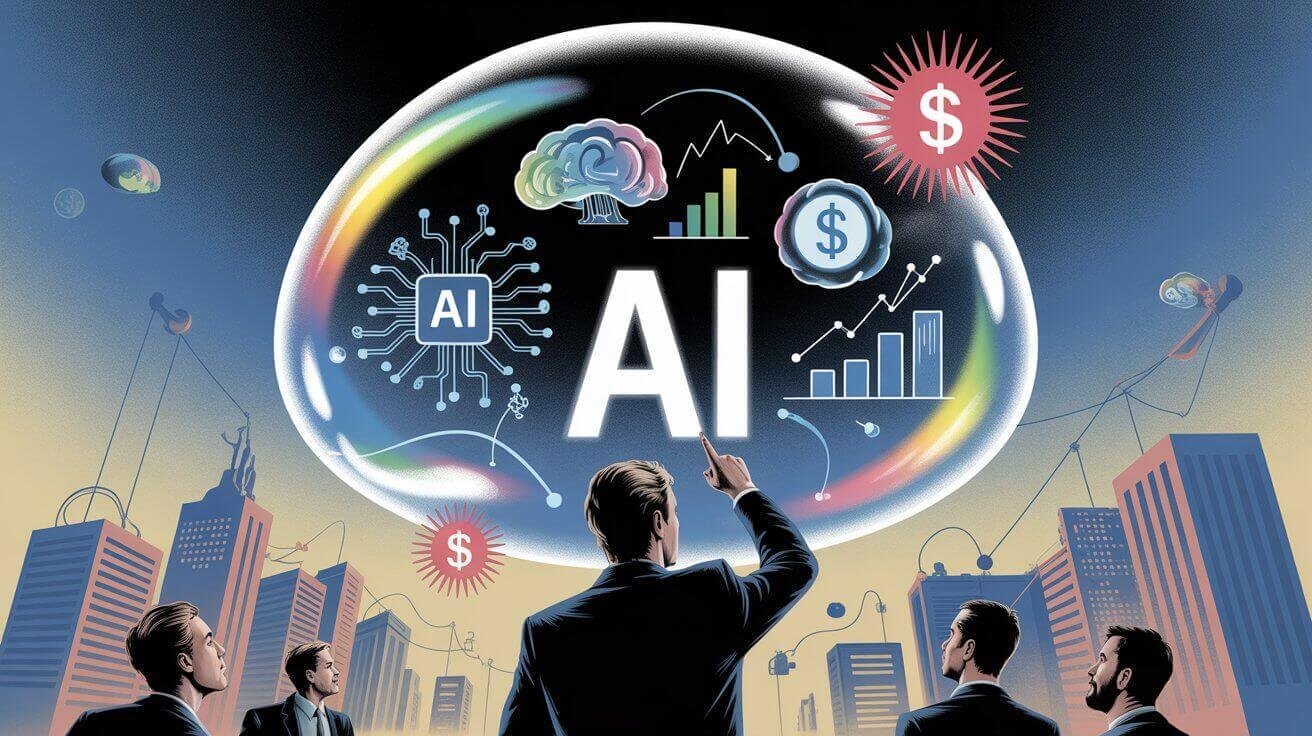

When the CEO of OpenAI tells you we’re in a bubble, maybe it’s time to listen. Last week, Sam Altman dropped a bombshell that sent shockwaves through Silicon Valley. Moreover, his Sam Altman AI bubble warning wasn’t just another tech prediction – it was a candid admission from the man who helped create the AI frenzy. But here’s what makes this Sam Altman AI bubble warning so unsettling: he’s not backing down from his trillion-dollar spending plans.
So is Sam Altman right about the AI bubble? Furthermore, what does his warning mean for investors who’ve been riding the AI wave? Let’s dive into the uncomfortable truths behind the hype.
Sam Altman AI Bubble Warning: What He Actually Said
During a dinner with reporters in San Francisco, Altman made a stunning confession. Additionally, he compared today’s AI frenzy to the dot-com bubble that devastated investors in 2000.
“Are we in a phase where investors as a whole are overexcited about AI? My opinion is yes,” Altman told The Verge. “When bubbles happen, smart people get overexcited about a kernel of truth.”
But here’s the twist – immediately after acknowledging the bubble, Altman announced plans to spend “trillions of dollars on data center construction in the not very distant future.” Meanwhile, OpenAI is approaching a $500 billion valuation despite never turning a profit.
It’s like watching someone point out a fire while pouring gasoline on it. Consequently, Altman’s mixed messages reveal the complex reality of today’s AI market.
AI Investment Bubble Indicators: The Warning Signs Are Everywhere
The Sam Altman AI bubble warning didn’t happen in a vacuum. Furthermore, multiple indicators suggest we’re deep in bubble territory:
Astronomical Valuations Without Profits OpenAI is valued at $300 billion and approaching $20 billion in annual recurring revenue, yet the company has never turned a profit. Meanwhile, AI startups with “three people and an idea” are receiving funding at sky-high valuations.
Massive Capital Expenditure AI sector capital expenditure has risen tenfold in just three years, now sucking up more than half of America’s investment. However, companies like Meta will spend over $60 billion on capital expenditures this year alone.
Disconnected User Economics Running an AI company means operating at a huge loss. It costs big AI models more to come up with answers than people pay. Consequently, every new user actually costs these companies money.
The Dot-Com Parallel: History Rhyming Again
Apollo Global Management chief economist Torsten Slok warned that “the top 10 companies in the S&P 500 today are more overvalued than they were in the 1990s.” Therefore, this isn’t just another tech trend – it’s potentially worse than the dot-com bubble.
During the dot-com era, companies like Pets.com burned through millions with no viable business model. Similarly, today’s AI companies are spending billions on infrastructure while struggling to monetize their products effectively.
But there’s a crucial difference: tech giants like Microsoft, Google, and Meta have massive cash flows funding their AI bets. Additionally, these companies aren’t relying purely on venture capital like dot-com startups did.
Real-World Consequences: When AI Enthusiasm Meets Reality
The Sam Altman AI bubble warning matters because real money is at stake. Furthermore, several concerning trends are already emerging:
Economic Distortion With all that money pouring into AI, investment in the rest of the economy has begun to decline, slowing growth. Consequently, the AI bubble is crowding out investment in other crucial sectors.
Unsustainable Business Models If OpenAI were as popular as Gmail, its 10 billion monthly users would cost the company $56 billion a year. However, the conversion rate from free to paying users remains dismally low at just 2.58%.
Infrastructure Overbuilding Companies are constructing massive data centers for AI workloads that may never materialize at projected scales. Meanwhile, electricity consumption for AI is becoming unsustainable.
What Investors Should Do: Practical Strategies for AI Bubble Survival
Given the Sam Altman AI bubble warning, here’s how smart investors are positioning themselves:
Diversify Beyond AI Don’t put all your eggs in the AI basket. Therefore, maintain exposure to other sectors that aren’t caught up in the hype cycle.
Focus on Fundamentals Nvidia today trades at around 38 times its trailing earnings, and 25 times its expected earnings over the next 12 months. While elevated, these valuations are far more reasonable than dot-com era extremes.
Look for Sustainable Business Models Invest in companies that are actually making money from AI, not just spending on it. Additionally, focus on firms with clear paths to profitability.
Prepare for Volatility If the fundamentals of the Magnificent Seven are sturdier than the online startups from a quarter-century ago, the bubble might be constructed from sturdier material. Nevertheless, expect significant market swings.
Future Implications: When Will the AI Bubble Burst?
The Sam Altman AI bubble warning raises the critical question: when will this end? Moreover, several scenarios could trigger a correction:
Earnings Disappointments If major AI companies start missing financial targets, investor confidence could evaporate quickly. Consequently, the market could experience a rapid correction.
Regulatory Crackdowns Governments are becoming more involved in overseeing AI technologies due to privacy, security, and ethical concerns. Therefore, new regulations could significantly impact profitability.
Macroeconomic Pressures Research firm Capital Economics thinks it’ll burst in 2026 because of higher interest rates and higher inflation. Additionally, economic recession could force investors toward safer assets.
Technical Reality Check As AI’s limitations become clearer, the gap between hype and reality may trigger a market reassessment. Furthermore, the recent DeepSeek controversy shows how quickly sentiment can shift.
The Long-Term Perspective: AI’s Real Value Beyond the Hype
Despite the Sam Altman AI bubble warning, AI isn’t going anywhere. However, the technology’s true impact may take longer to materialize than investors expect.
The dot-com bubble of the 1990s saw much higher over-investment and overvaluation than what the AI industry is experiencing today, yet its collapse paved the way for giants like Google and Amazon. Similarly, today’s AI correction could separate the wheat from the chaff.
The companies that survive will likely be those with:
- Sustainable business models
- Real customer demand
- Efficient operations
- Strong cash positions
Conclusion: Taking Sam Altman’s Warning Seriously
The Sam Altman AI bubble warning forces us to confront an uncomfortable truth: even AI’s biggest cheerleader acknowledges we’re in bubble territory. Moreover, his continued massive spending plans suggest the bubble isn’t deflating anytime soon.
But bubbles don’t last forever. Therefore, smart investors need to balance optimism about AI’s potential with realism about current valuations. Additionally, the key is positioning yourself to benefit from AI’s long-term value while protecting against short-term volatility.
As Altman himself noted, there’s a real kernel of truth beneath all this excitement. Consequently, AI will likely transform our world – but perhaps not as quickly or profitably as current prices suggest. The Sam Altman AI bubble warning isn’t just about market timing; it’s about approaching transformative technology with both enthusiasm and caution.